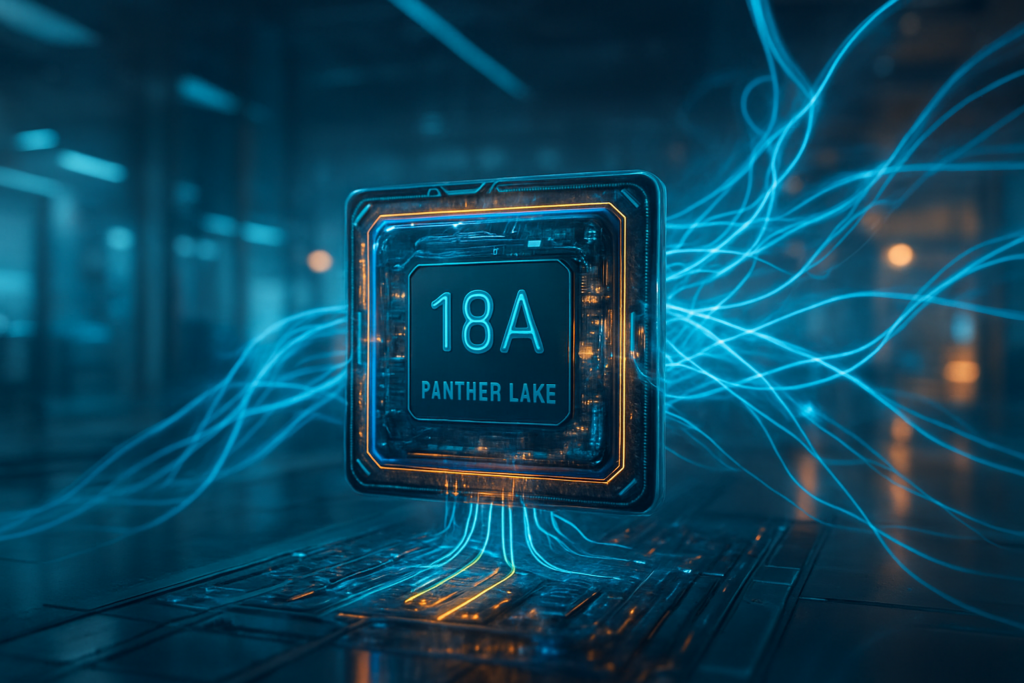
In a watershed moment for the global semiconductor industry, Intel (NASDAQ: INTC) has officially launched its highly anticipated "Panther Lake" processors at CES 2026, marking the first commercial arrival of the Intel 18A process node. While the launch itself represents a technical triumph for the Santa Clara-based chipmaker, the shockwaves were amplified by the mid-January confirmation of a landmark foundry agreement with Apple (NASDAQ: AAPL). This partnership will see Intel’s U.S.-based facilities produce future 18A silicon for Apple’s entry-level Mac and iPad lineups, signaling a dramatic shift in the "Apple Silicon" supply chain.
The dual announcement signals that Intel’s "Five Nodes in Four Years" strategy has successfully reached its climax, potentially reclaiming the manufacturing crown from rivals. By securing Apple—long the crown jewel of TSMC (TPE: 2330)—as an "anchor tenant" for its Intel Foundry services, Intel has not only validated its 1.8nm-class manufacturing capabilities but has also reshaped the geopolitical landscape of high-end chip production. For the AI industry, these developments provide a massive influx of local compute power, as Panther Lake sets a new high-water mark for "AI PC" performance.
The "Panther Lake" lineup, officially branded as the Core Ultra Series 3, represents a radical departure from its predecessors. Built on the Intel 18A node, the processors introduce two foundational innovations: RibbonFET (Gate-All-Around) transistors and PowerVia (backside power delivery). RibbonFET replaces the long-standing FinFET architecture, wrapping the gate around the channel on all sides to significantly reduce power leakage and increase switching speeds. Meanwhile, PowerVia decouples signal and power lines, moving the latter to the back of the wafer to improve thermal management and transistor density.
From an AI perspective, Panther Lake features the new NPU 5, a dedicated neural processing engine delivering 50 TOPS (Trillion Operations Per Second). When integrated with the new Xe3 "Celestial" graphics architecture and updated "Cougar Cove" performance cores, the total platform AI throughput reaches a staggering 180 TOPS. This capacity is specifically designed to handle "on-device" Large Language Models (LLMs) and generative AI agents without the latency or privacy concerns associated with cloud-based processing. Industry experts have noted that the 50 TOPS NPU comfortably exceeds Microsoft’s (NASDAQ: MSFT) updated "Copilot+" requirements, establishing a new standard for Windows-based AI hardware.
Compared to previous generations like Lunar Lake and Arrow Lake, Panther Lake offers a 35% improvement in multi-threaded efficiency and a 77% boost in gaming performance through its Celestial GPU. Initial reactions from the research community have been overwhelmingly positive, with many analysts highlighting that Intel has successfully closed the "performance-per-watt" gap with Apple and Qualcomm (NASDAQ: QCOM). The use of the 18A node is the critical differentiator here, providing the density and efficiency gains necessary to support sophisticated AI workloads in thin-and-light laptop form factors.
The implications for the broader tech sector are profound, particularly regarding the Apple-Intel foundry deal. For years, Apple has been the exclusive partner for TSMC’s most advanced nodes. By diversifying its production to Intel’s Arizona-based Fab 52, Apple is hedging its bets against geopolitical instability in the Taiwan Strait while benefiting from U.S. government incentives under the CHIPS Act. This move does not yet replace TSMC for Apple’s flagship iPhone chips, but it creates a competitive bidding environment that could drive down costs for Apple’s mid-range silicon.
For Intel’s foundry rivals, the deal is a shots-fired moment. While TSMC remains the industry leader in volume, Intel’s ability to stabilize 18A yields at over 60%—a figure leaked by KeyBanc analysts—proves that it can compete at the sub-2nm level. This creates a strategic advantage for AI startups and tech giants alike, such as NVIDIA (NASDAQ: NVDA) and AMD (NASDAQ: AMD), who may now look toward Intel as a viable second source for high-performance AI accelerators. The "Intel Foundry" brand, once viewed with skepticism, now possesses the ultimate credential: the Apple seal of approval.
Furthermore, this development disrupts the established order of the "AI PC" market. By integrating such high AI compute directly into its mainstream processors, Intel is forcing competitors like Qualcomm and AMD to accelerate their own roadmaps. As Panther Lake machines hit shelves in Q1 2026, the barrier to entry for local AI development is dropping, potentially reducing the reliance of software developers on expensive NVIDIA-based cloud instances for everyday productivity tools.
Beyond the immediate technical and corporate wins, the Panther Lake launch fits into a broader trend of "AI Sovereignty." As nations and corporations seek to secure their AI supply chains, Intel’s resurgence provides a Western alternative to East Asian manufacturing dominance. This fits perfectly with the 2026 industry theme of localized AI—where the "intelligence" of a device is determined by its internal silicon rather than its internet connection.
The comparison to previous milestones is striking. Just as the transition to 64-bit computing or multi-core processors redefined the 2000s, the move to 18A and dedicated NPUs marks the transition to the "Agentic Era" of computing. However, this progress brings potential concerns, notably the environmental impact of manufacturing such dense chips and the widening digital divide between users who can afford "AI-native" hardware and those who cannot. Unlike previous breakthroughs that focused on raw speed, the Panther Lake era is about the autonomy of the machine.
Intel’s success with "5N4Y" (Five Nodes in Four Years) will likely be remembered as one of the greatest corporate turnarounds in tech history. In 2023, many predicted Intel would eventually exit the manufacturing business. By January 2026, Intel has not only stayed the course but has positioned itself as the only company in the world capable of both designing and manufacturing world-class AI processors on domestic soil.
Looking ahead, the roadmap for Intel and its partners is already taking shape. Near-term, we expect to see the first Apple-designed chips rolling off Intel’s production lines by early 2027, likely powering a refreshed MacBook Air or iPad Pro. Intel is also already teasing its 14A (1.4nm) node, which is slated for development in late 2027. This next step will be crucial for maintaining the momentum generated by the 18A success and could potentially lead to Apple moving its high-volume iPhone production to Intel fabs by the end of the decade.
The next frontier for Panther Lake will be the software ecosystem. While the hardware can now support 180 TOPS, the challenge remains for developers to create applications that utilize this power effectively. We expect to see a surge in "private" AI assistants and real-time local video synthesis tools throughout 2026. Experts predict that by CES 2027, the conversation will shift from "how many TOPS" a chip has to "how many agents" it can run simultaneously in the background.
The launch of Panther Lake at CES 2026 and the subsequent Apple foundry deal mark a definitive end to Intel’s era of uncertainty. Intel has successfully delivered on its technical promises, bringing the 18A node to life and securing the world’s most demanding customer in Apple. The Core Ultra Series 3 represents more than just a faster processor; it is the foundation for a new generation of AI-enabled devices that promise to make local, private, and powerful artificial intelligence accessible to the masses.
As we move further into 2026, the key metrics to watch will be the real-world battery life of Panther Lake laptops and the speed at which the Intel Foundry scales its 18A production. The semiconductor industry has officially entered a new competitive era—one where Intel is no longer chasing the leaders, but is once again setting the pace for the future of silicon.
This content is intended for informational purposes only and represents analysis of current AI developments.
TokenRing AI delivers enterprise-grade solutions for multi-agent AI workflow orchestration, AI-powered development tools, and seamless remote collaboration platforms.
For more information, visit https://www.tokenring.ai/.