As the calendar turns to January 16, 2026, the artificial intelligence landscape is witnessing a seismic shift in how hardware powers the next generation of autonomous systems. For years, NVIDIA (NASDAQ: NVDA) held an uncontested throne as the primary provider of the high-performance "brains" inside Level 4 (L4) autonomous vehicles and generative AI data centers. However, a new era of "Silicon Sovereignty" has arrived, characterized by major tech players and automakers abandoning off-the-shelf solutions in favor of bespoke, in-house silicon.
Leading this charge is Rivian (NASDAQ: RIVN), which recently unveiled its proprietary Rivian Autonomy Processor 1 (RAP1). Designed specifically for L4 autonomy and "Physical AI," the RAP1 represents a bold gamble on vertical integration. By moving away from NVIDIA's Drive Orin platform, Rivian joins the ranks of "Big Tech" giants like Alphabet (NASDAQ: GOOGL), Amazon (NASDAQ: AMZN), and Meta (NASDAQ: META) in a strategic quest to reclaim profit margins and optimize performance for specialized AI workloads.
The RAP1 Architecture: Engineering the End-to-End Driving Machine
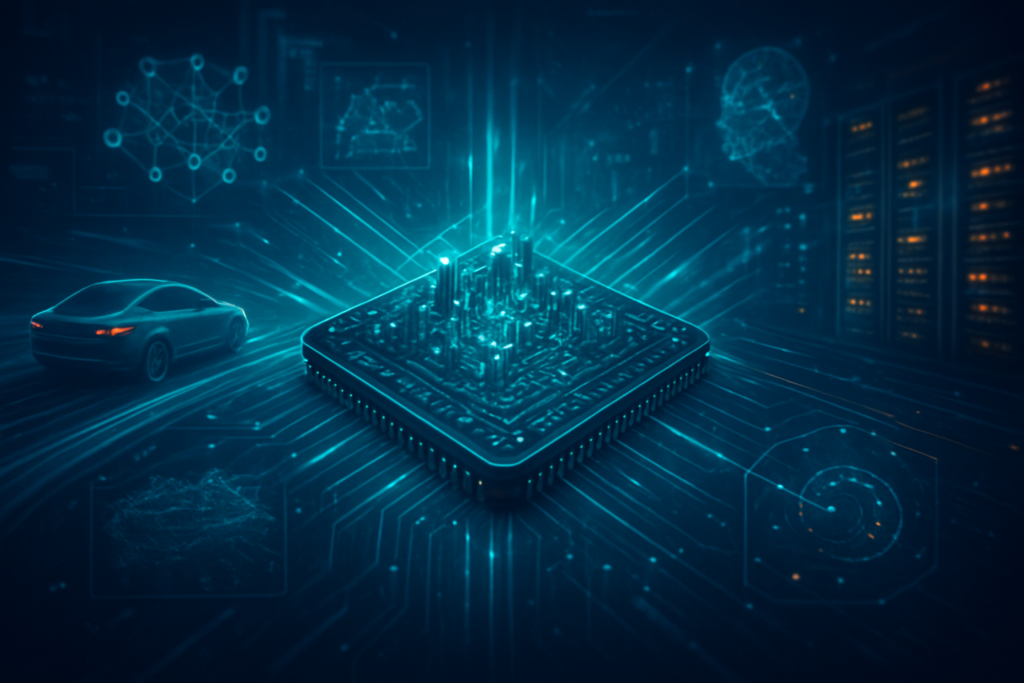
Unveiled during Rivian’s "Autonomy & AI Day" in late 2025, the RAP1 chip is a masterclass in domain-specific architecture. Fabricated on TSMC’s (NYSE: TSM) advanced 5nm process, the chip utilizes the Armv9 architecture to power its third-generation Autonomy Compute Module (ACM3). While previous Rivian models relied on dual NVIDIA Drive Orin systems, the RAP1-driven ACM3 delivers a staggering 3,200 sparse INT8 TOPS (Trillion Operations Per Second) in its flagship dual-chip configuration—effectively quadrupling the raw compute power of its predecessor.
The technical brilliance of the RAP1 lies in its optimization for Rivian's "Large Driving Model" (LDM), a transformer-based end-to-end neural network. Unlike general-purpose GPUs that must handle a wide variety of tasks, the RAP1 features a proprietary "RivLink" low-latency interconnect and a 3rd-gen SparseCore optimized for the high-speed sensor fusion required for L4 navigation. This specialization allows the chip to process 5 billion pixels per second from a suite of 11 cameras and long-range LiDAR with 2.5x greater power efficiency than off-the-shelf hardware.
Initial reactions from the AI research community have been overwhelmingly positive, particularly regarding Rivian’s use of Group-Relative Policy Optimization (GRPO) to train its driving models. By aligning its software architecture with custom silicon, Rivian has demonstrated that performance-per-watt—not just raw TOPS—is the new metric of success in the automotive sector. "Rivian has moved the goalposts," noted one lead analyst from Gartner. "They’ve proven that a smaller, agile OEM can successfully design bespoke hardware that outperforms the giants."
Dismantling the 'NVIDIA Tax' and the Competitive Landscape
The shift toward custom silicon is, at its core, an economic revolt against the "NVIDIA tax." For companies like Amazon and Google, the high cost and power requirements of NVIDIA’s H100 and Blackwell chips have become a bottleneck to scaling profitable AI services. By developing its own TPU v7 (Ironwood), Google has significantly expanded its margins for Gemini-powered "thinking models." Similarly, Amazon’s Trainium3, unveiled at re:Invent 2025, offers 40% better energy efficiency, allowing AWS to maintain price leadership in the cloud compute market.
For Rivian, the financial implications are equally profound. CEO RJ Scaringe recently noted that in-house silicon reduces the bill of materials (BOM) for their autonomy suite by hundreds of dollars per vehicle. This cost reduction is vital as Rivian prepares to launch its more affordable R2 and R3 models in late 2026. By controlling the silicon, Rivian secures its supply chain and avoids the fluctuating lead times and premium pricing associated with third-party chip designers.
NVIDIA, however, is not standing still. At CES 2026, CEO Jensen Huang responded to the rise of custom silicon by accelerating the roadmap for the "Rubin" architecture, the successor to Blackwell. NVIDIA's strategy is to make its hardware so efficient and its "software moat"—including the Omniverse simulation environment—so deep that only the largest hyperscalers will find it cost-effective to build their own. While NVIDIA’s automotive revenue reached a record $592 million in early 2026, its "share of new designs" among EV startups has reportedly slipped from 90% to roughly 65% as more companies pursue Silicon Sovereignty.
Silicon Sovereignty: A New Era of AI Vertical Integration
The emergence of the RAP1 chip is part of a broader trend that analysts have dubbed "Silicon Sovereignty." This movement represents a fundamental change in the AI landscape, where the competitive advantage is no longer just about who has the most data, but who has the most efficient hardware to process it. "The AI arms race has evolved," a Morgan Stanley report stated in early 2026. "Players with the deepest pockets are rewriting the rules by building their own arsenals, aiming to reclaim the 75% gross margins currently being captured by NVIDIA."
This trend also raises significant questions about the future of the semiconductor industry. Meta’s recent acquisition of the chip startup Rivos and its subsequent shift toward RISC-V architecture suggests that "Big Tech" is looking for even greater independence from traditional instruction set architectures like ARM or x86. This move toward open-source silicon standards could further decentralize power in the industry, allowing companies to tailor every transistor to their specific agentic AI workflows.
However, the path to Silicon Sovereignty is fraught with risk. The R&D costs of designing a custom 5nm or 3nm chip are astronomical, often reaching hundreds of millions of dollars. For a company like Rivian, which is still navigating the "EV winter" of 2025, the success of the RAP1 is inextricably linked to the commercial success of its upcoming R2 platform. If volume sales do not materialize, the investment in custom silicon could become a heavy anchor rather than a propellant.
The Horizon: Agentic AI and the RISC-V Revolution
Looking ahead, the next frontier for custom silicon lies in the rise of "Agentic AI"—autonomous agents capable of reasoning and executing complex tasks without human intervention. In 2026, we expect to see Google and Amazon deploy specialized "Agentic Accelerators" that prioritize low-latency inference for proactive AI assistants. These chips will likely feature even more advanced HBM4 memory and dedicated hardware for "chain-of-thought" processing.
In the automotive sector, expect other manufacturers to follow Rivian’s lead. While legacy OEMs like Mercedes-Benz and Toyota remain committed to NVIDIA’s DRIVE Thor platform for now, the success or failure of Rivian’s ACM3 will be a litmus test for the industry. If Rivian can deliver on its promise of a $2,000 hardware stack for L4 autonomy, it will put immense pressure on other automakers to either develop their own silicon or demand significant price concessions from NVIDIA.
The biggest challenge facing this movement remains software compatibility. While Amazon has made strides with native PyTorch support for Trainium3, the "CUDA moat" that NVIDIA has built over the last decade remains a formidable barrier. The success of custom silicon in 2026 and beyond will depend largely on the industry's ability to develop robust, open-source compilers that can seamlessly bridge the gap between diverse hardware architectures.
Conclusion: A Specialized Future
The announcement of Rivian’s RAP1 chip and the continued evolution of Google’s TPU and Amazon’s Trainium mark the end of the "one-size-fits-all" era for AI hardware. We are witnessing a fragmentation of the market into highly specialized silos, where the most successful companies are those that vertically integrate their AI stacks from the silicon up to the application layer.
This development is a significant milestone in AI history, signaling that the industry has matured beyond the initial rush for raw compute and into a phase of optimization and economic sustainability. In the coming months, all eyes will be on the performance of the RAP1 in real-world testing and the subsequent response from NVIDIA as it rolls out the Rubin platform. The battle for Silicon Sovereignty has only just begun, and the winners will define the technological landscape for the next decade.
This content is intended for informational purposes only and represents analysis of current AI developments.
TokenRing AI delivers enterprise-grade solutions for multi-agent AI workflow orchestration, AI-powered development tools, and seamless remote collaboration platforms.
For more information, visit https://www.tokenring.ai/.