Rising penalty exposure, multimodal complexity, and demand for predictive logistics intelligence accelerate adoption of corridor-level analytics and control tower platforms
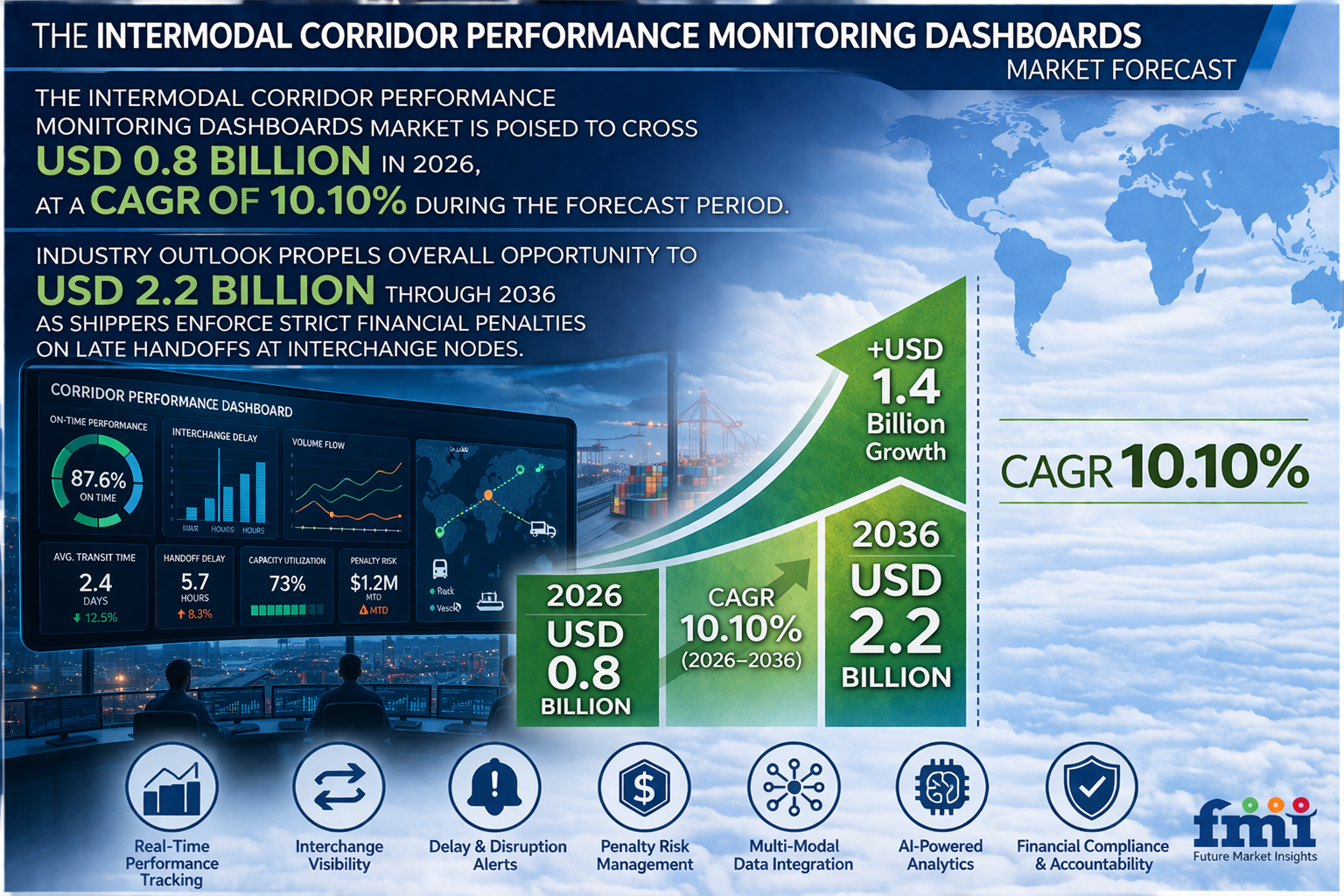
NEWARK, DE / ACCESS Newswire / April 9, 2026 / According to the latest analysis by Future Market Insights, the global intermodal corridor performance monitoring dashboards market is entering a high-growth transformation phase as logistics providers and shippers shift from reactive reporting to real-time operational control. Valued at USD 0.7 billion in 2025, the market is projected to reach USD 0.8 billion in 2026 and expand significantly to USD 2.2 billion by 2036, registering a CAGR of 10.1% during the forecast period.
This growth reflects a structural shift in freight logistics, where increasing SLA enforcement, rising multimodal complexity, and financial penalties for delays are redefining how corridor performance is monitored and managed. What was once a reporting tool is now evolving into a mission-critical decisioning system that directly impacts profitability, service reliability, and network efficiency.
Get detailed market forecasts, competitive benchmarking, and pricing trends:
https://www.futuremarketinsights.com/reports/sample/rep-gb-32606
Market Value Analysis: Real-Time Visibility Becomes a Financial Imperative
Between 2026 and 2030, adoption of intermodal corridor dashboards is expected to accelerate as 3PLs and shippers face mounting pressure from SLA penalties tied to missed delivery windows and inefficient handoffs. Rail-to-road and port-to-inland transfers are particularly sensitive, where delays cascade across the network and quickly translate into financial losses.
Organizations are increasingly prioritizing:
Real-time corridor dashboards with unified KPI visibility across modes
Predictive ETA and delay analytics for proactive rerouting
Integration with rail, port, and trucking data systems via APIs
Exception alerting for dwell time, congestion, and missed handoffs
Control tower capabilities for dynamic network orchestration
Failure to deploy real-time monitoring systems leaves operators reliant on retrospective data, exposing them to avoidable penalties and reduced operational agility.
From 2030 to 2036, growth will be driven by deeper integration of AI-driven predictive analytics, expansion of cross-border logistics networks, and increasing demand for synchronized multimodal execution.
Technology Evolution: AI-Driven Analytics and Data Integration Redefine Visibility
The evolution of intermodal corridor dashboards is being shaped by advancements in data integration, predictive analytics, and cloud-based platforms. These systems are designed to convert fragmented logistics data into actionable insights in real time.
Key innovations include:
AI-powered predictive analytics for delay forecasting and route optimization
Multi-source data normalization across rail, port, and road networks
Cloud-based dashboards enabling multi-party access and collaboration
Real-time event streaming and anomaly detection
Digital twin models for corridor simulation and planning
A key challenge lies in harmonizing data from legacy systems with modern platforms. Differences in data standards and integration complexity can delay deployment and impact accuracy.
An industry analyst notes:
"Corridor visibility is no longer about tracking shipments-it is about controlling outcomes. The ability to predict and prevent disruptions defines competitive advantage in modern logistics."
Corridor Monitoring Becomes Core to Logistics Profitability
As supply chains become more interconnected, corridor monitoring dashboards are becoming essential for maintaining operational efficiency and financial control. These platforms enable organizations to act before disruptions escalate into costly failures.
Core capabilities include:
Real-time tracking of transit time, dwell, and reliability metrics
Early detection of bottlenecks and congestion points
Automated enforcement of SLA compliance and penalty attribution
Optimization of asset utilization and network flow
Seamless coordination across multiple logistics partners
This transformation is elevating corridor dashboards from analytical tools to central command systems within logistics operations.
Speak to Analyst: Customize insights for your business strategy:
https://www.futuremarketinsights.com/customization-available/rep-gb-32606
Segment Spotlight
Software Leads Component Segment (68.0%)
Core value lies in analytics, KPI visualization, and real-time decision support.
Cloud Deployment Dominates (71.0%)
Enables scalable, multi-party access across geographically distributed networks.
Transit Time Monitoring Leads (31.0%)
Critical for ETA accuracy, delay prediction, and operational planning.
Rail Operators Lead Buyer Segment (29.0%)
Direct responsibility for corridor performance drives adoption.
Network Planning Leads Use Case (27.0%)
Shift from reactive tracking to predictive and strategic optimization.
Regional Insights: Infrastructure Expansion and Digitization Drive Growth
The intermodal corridor performance monitoring dashboards market is expanding across regions with strong logistics infrastructure development and digital transformation initiatives.
Country |
CAGR (2026-2036) |
Key Growth Drivers |
|---|---|---|
India |
11.4% |
Dedicated freight corridors and high-density traffic management |
China |
10.8% |
Export-driven rail logistics modernization |
Brazil |
10.5% |
Commodity supply chain digitization |
United States |
9.7% |
Enterprise logistics visibility and SLA enforcement |
Germany |
9.2% |
Optimization of high-traffic rail networks |
Netherlands |
9.0% |
Port-centric logistics integration |
United Kingdom |
8.8% |
Infrastructure constraints and data-driven optimization |
Regional growth variations are driven by infrastructure maturity, digitization levels, and the complexity of intermodal networks.
Opportunities: Building Intelligent Logistics Control Towers
Key opportunities shaping the market include:
Integration of corridor dashboards with emissions tracking systems
Expansion of cold chain monitoring within intermodal networks
Development of cross-enterprise collaboration platforms
Adoption of predictive routing and congestion avoidance tools
Localization of data integration solutions for regional networks
These opportunities are enabling vendors to move beyond visualization toward full-scale logistics orchestration platforms.
Competitive Landscape: Data Integration and Platform Capability Define Leadership
The market remains moderately fragmented, with competition driven by platform scalability, integration capabilities, and analytics sophistication.
Leading companies include:
Wabtec
project44
SAP
Oracle
Hitachi Rail
Siemens Mobility
Trimble
Competitive differentiation is driven by:
Ability to integrate multi-modal data sources seamlessly
Strength of predictive analytics and AI capabilities
Scalability across global logistics networks
Support for open APIs and interoperability
Real-time processing and dashboard responsiveness
Future Outlook: Corridor Intelligence Becomes the Backbone of Logistics
Looking ahead to 2036, intermodal corridor performance monitoring dashboards will become foundational to global logistics operations.
Key trends include:
Expansion of AI-driven predictive logistics platforms
Increased reliance on real-time control towers for network orchestration
Growth of cross-border digital freight corridors
Integration of sustainability and emissions tracking metrics
Alignment of logistics execution with data-driven decisioning
As supply chains grow more complex and time-sensitive, intermodal corridor dashboards will transition from performance tracking tools to critical enablers of efficiency, resilience, and profitability in modern freight ecosystems.
Unlock 360° insights for strategic decision making and investment planning:
https://www.futuremarketinsights.com/checkout/32606
Browse More Technology Industry Reports:
Video Game Market - https://www.futuremarketinsights.com/reports/video-game-market
Parking Management Market - https://www.futuremarketinsights.com/reports/parking-management-market
Air Flow Monitoring System Market - https://www.futuremarketinsights.com/reports/air-flow-monitoring-system-market
A2P Messaging Market - https://www.futuremarketinsights.com/reports/a2p-messaging-market
FPGA Market - https://www.futuremarketinsights.com/reports/fpga-market
About Future Market Insights (FMI)
Future Market Insights (FMI) is a leading provider of market intelligence and consulting services, serving clients in over 150 countries. Headquartered in Delaware, USA, with a global delivery center in India and offices in the UK and UAE, FMI delivers actionable insights to businesses across industries including automotive, technology, consumer products, manufacturing, energy, and chemicals.
An ESOMAR-certified research organization, FMI provides custom and syndicated market reports and consulting services, supporting both Fortune 1,000 companies and SMEs. Its team of 300+ experienced analysts ensures credible, data-driven insights to help clients navigate global markets and identify growth opportunities.
For Press & Corporate Inquiries
Rahul Singh
AVP - Marketing and Growth Strategy
Future Market Insights, Inc.
+91 8600020075
For Sales - sales@futuremarketinsights.com
For Media - Rahul.singh@futuremarketinsights.com
For web - https://www.futuremarketinsights.com/
SOURCE: Future Market Insights, Inc.
View the original press release on ACCESS Newswire