Embedded Finance Index exposes the compliance gap behind recent bank-fintech failures; Updated quarterly, it’s the first public database that maps 6,000+ fintech and embedded finance companies across the $185B market
Apideck, the unified API provider for the finance and accounting industry, today announced the launch of its Embedded Finance Index, the first public, citable, quarterly benchmark of the companies and providers that make up the embedded finance market. The Embedded Finance Index outlines the relationships between embedded finance companies and vendors, showing who buys from whom. It covers 6,000+ fintech and embedded finance companies, 1,297 verified providers across 12 stack layers, 5,000+ pre-rendered company profiles, and roughly $252B in venture capital sitting behind the vendor base.
This press release features multimedia. View the full release here: https://www.businesswire.com/news/home/20261001997176/en/
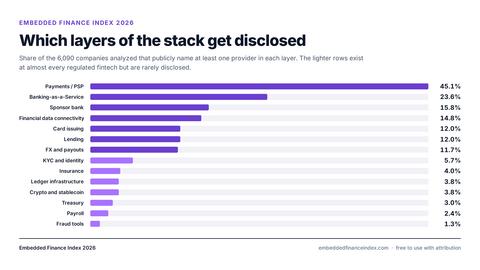
Apideck Embedded Finance Index: The layers of the stack that get disclosed, include Payments/PSP, Banking-as-a-Service, Sponsor Bank, Financial Data Connectivity, Card Issuing, Lending, FX and Payouts, KYC and Identity, Insurance, Ledger Infrastructure, Crypto and Stablecoin, Treasury, Payroll and Fraud Tools. The graph shows the share of the 6,090 companies analyzed that publicly name at least one provider in each layer. The lighter rows exist at almost every regulated fintech but are rarely disclosed.
Embedded payments represent a $185B B2B market opportunity, but the landscape has remained opaque until now. Existing market maps are built from the vendor side and reflect what providers want to sell. Apideck’s Embedded Finance Index inverts the lens.
“Apideck has operated the Open Banking Tracker for eight years. It maps the global open banking ecosystem, tracking thousands of financial institutions and providers across dozens of jurisdictions, so you can see which companies sell what in the industry. What we didn't know was which companies buy from whom. The Embedded Finance Index answers that question,” said Apideck CEO and founder Gertjan de Wilde. “We published the gaps in our own data alongside the findings because a benchmark you cannot audit is not a benchmark. We’ve also ensured the Embedded Finance Report is agent-readable because that is how the next generation of fintech research will be consumed.”
Highlights from Apideck’s first quarterly Embedded Finance Index include:
- Dataset reveals significant transparency gap: Due to regulatory requirements, 965 companies publicly name their sponsor bank. Only 345 name their KYC vendor, and 80 name their fraud-tooling vendor. The compliance half of the embedded finance stack discloses at much lower rates than the payments half, and it has failed first in recent enforcement cycles (Synapse, Blue Ridge, Evolve, Solaris, Railsr, Intergiro). Every failure is sourced to the originating OCC order, Fed enforcement action, BaFin measure, Finansinspektionen sanction, or court docket.
- Every app is becoming a bank: Embedded finance is becoming the default playbook for vertical SaaS, marketplaces, B2B platforms, and even non-financial brands.
- Stripe leads payment service providers with 595 disclosed buyers across the dataset, one of only two vendors with a concentration above 5% in any infrastructure layer (and a disclosure-adjusted floor: the real share is higher).
- Evolve Bank & Trust leads Banking-as-a-Service with 64 disclosed buyers.
- Plaid leads financial data connectivity with 248 buyers, more than every other open banking aggregator combined.
- Regional oligopolies show no overlap: The top three Banking-as-a-Service providers in the US (Sutton Bank, Evolve Bank & Trust, Cross River), the UK (ClearBank, Modulr, Railsr), and the EU (Swan, Mangopay, Treezor) do not overlap. Three separate regional oligopolies make up what is often described as one global market.
- Financial data connectivity is the most consolidated infrastructure layer: New open finance regulations will likely change this landscape as they extend data access rights to accounting, payroll, investments, pensions, insurance, and tax. Unified API providers (Apideck, Codat, Finch) that can aggregate and normalize that access become increasingly critical infrastructure. The Index will track which providers customers actually disclose as rules go into effect.
Every entry in the Embedded Finance Index dataset is derived from public customer-side evidence: subprocessor lists, regulatory footers, trust pages, customer announcements, and 517 indexed articles from the Embedded Finance Review. Every vendor attribution links back to a source URL, every named provider is cross-referenced against the Open Banking Tracker directory, and evidence is graded across three tiers, with regulatory disclosures outranking press mentions, which outrank structural integration signals. Additionally, the entire Embedded Finance Index ships as plain-text Markdown, making it agent-readable and easy for LLMs to digest.
Access the Apideck Embedded Finance Index Press Kit here or visit Apideck.com to learn more.
About Apideck
Apideck is the unified API platform for B2B SaaS, with 200+ connectors across accounting ERP, CRM, HRIS, and commerce. The company serves customers including Airbnb, Zoom, BILL, and PTC. Apideck is a member of the OpenAPI Initiative, the first unified API company to join, and operates its own production MCP server. Apideck has operated Open Banking Tracker, the global directory of embedded finance, open banking, BaaS, and card-issuing providers since 2018, covering 54,000+ financial institutions across 30+ jurisdictions, and the Open Finance Map, which covers 80+ open finance and open banking regulatory frameworks worldwide.
Headquartered in Antwerp, with an additional office in San Francisco, Apideck is a privately held company backed by Airbridge Equity Partners and PMV. Follow Apideck on LinkedIn and X, or learn more at https://apideck.com.
APIDECK FREQUENTLY ASKED QUESTIONS
Who is Apideck, and what does the company do?
Apideck is a unified API platform for B2B SaaS, offering 200+ connectors across accounting, ERP, CRM, and HRIS so companies can ship integrations in weeks, not months. It also operates the Open Banking Tracker, the Open Finance Map, and now the Apideck Embedded Finance Index.
What is the Apideck Embedded Finance Index?
The Apideck Embedded Finance Index is the first public, citable, quarterly benchmark of the embedded finance market, covering 6,000+ companies and 1,297 verified providers across 12 stack layers. Unlike vendor-built market maps, it shows who buys from whom.
How big is the embedded finance market that Apideck’s Embedded Finance Index tracks?
Embedded payments represent a $185B B2B market opportunity, with roughly $252B in venture capital behind the vendor base.
What does the Index reveal about compliance transparency?
965 companies publicly name their sponsor bank, but only 345 name their KYC vendor and just 80 name their fraud-tooling vendor. Apideck notes this is the layer that has failed first in recent enforcement actions like Synapse and Evolve.
Which vendors lead each layer of the stack?
Stripe leads payment service providers with 595 disclosed buyers, Evolve Bank & Trust leads Banking-as-a-Service with 64, and Plaid leads financial data connectivity with 248, more than every other open banking aggregator combined.
Is the "global" Banking-as-a-Service market actually one market?
No, the top three BaaS providers in the US, UK, and EU show zero overlap, pointing to three separate regional oligopolies rather than one global market.
Is the Index built for AI agents to read?
Yes. Every entry in the Embedded Finance Index is sourced and graded across three evidence tiers, and the full Index ships as plain-text Markdown for LLM consumption. Apideck CEO and founder Gertjan de Wilde believes this will be central to how fintech research is consumed going forward.
View source version on businesswire.com: https://www.businesswire.com/news/home/20261001997176/en/
Apideck's Embedded Finance Index is the first public, citable, quarterly benchmark of the embedded finance market, covering 6,000+ companies and 1,297 verified providers across 12 stack layers. Unlike vendor-built market maps, it shows who buys from whom.
Contacts
Media Contacts:
Mindy M. Hull
Mercury Global Partners for Apideck
+1 415 889 9977 (USA) or +31 6 25047680 (NL)
apideck@wearemgp.com
Michael Held-Hernandez
Mercury Global Partners for Apideck
+1 480 306 1154 (USA)
apideck@wearemgp.com