Date: January 23, 2026
Introduction
As the global security landscape undergoes its most significant realignment since the end of the Cold War, few companies find themselves as centrally positioned as Northrop Grumman (NYSE: NOC). In the opening weeks of 2026, the aerospace and defense giant has captured investor attention by raising its sales forecast, driven by a "super-cycle" of defense modernization and the accelerated production of its crown jewel: the B-21 Raider. With a record backlog exceeding $91 billion and a strategic pivot toward next-generation missile defense, Northrop Grumman is no longer just a legacy defense contractor; it is the primary architect of the U.S. "deterrence-by-denial" strategy. This article explores the company’s recent financial surge, its technological dominance, and the risks inherent in its multi-billion-dollar government partnerships.
Historical Background
The entity known as Northrop Grumman was forged in the crucible of the 1990s defense consolidation. However, its roots stretch back to the dawn of aviation. Grumman Aircraft Engineering Corporation, founded in 1929 by Leroy Grumman, became the backbone of the U.S. Navy’s carrier fleet during World War II with iconic fighters like the Hellcat. Simultaneously, Northrop Aircraft Company, founded in 1939 by Jack Northrop, gained fame for its radical "flying wing" designs, a precursor to modern stealth technology.
The two giants merged in 1994, a $2.1 billion marriage of necessity following the Cold War’s end. Over the subsequent decades, Northrop Grumman aggressively expanded through acquisitions, most notably the 2002 purchase of TRW Inc. (expanding its space and laser capabilities) and the 2018 acquisition of Orbital ATK. The latter, valued at $9.2 billion, transformed the company into a leader in missile and rocket propulsion, a move that looks increasingly prescient as the space domain becomes a primary theater of military competition.
Business Model
Northrop Grumman operates a diversified but highly specialized business model divided into four primary segments:
- Aeronautics Systems: The home of the B-21 Raider and the F-35 center fuselage production. This segment focuses on high-end stealth, autonomous systems, and long-range strike capabilities.
- Space Systems: Providing end-to-end space solutions, from the James Webb Space Telescope to military communication satellites and the propulsion systems for NASA’s Artemis program.
- Mission Systems: A high-margin segment specialized in advanced sensors, electronic warfare, and cyber capabilities—the "brain" of modern combat platforms.
- Defense Systems: Managing the lifecycle of military hardware and the modernization of the U.S. nuclear triad, including the critical Sentinel ICBM program.
Its customer base is predominantly the U.S. Department of Defense (DoD) and intelligence agencies, though international sales to NATO allies and Pacific partners have grown significantly, reaching 32% growth in late 2025.
Stock Performance Overview
As of late January 2026, Northrop Grumman’s stock is trading near record highs around the $670 mark.
- 1-Year Performance: The stock has climbed approximately 34% over the past year. This rally was fueled by the transition of the B-21 Raider into Low-Rate Initial Production (LRIP) and a broader sector rotation into "safe-haven" defense assets amid global instability.
- 5-Year Performance: Long-term investors have seen gains of over 130%. NOC has consistently outperformed the S&P 500 during this period, benefiting from the U.S. pivot toward "Great Power Competition" with China and Russia.
- 10-Year Performance: Over the last decade, the stock has delivered a total return of approximately 262%, characterized by steady dividend growth and a series of aggressive share buyback programs that reduced share count while earnings expanded.
Financial Performance
In its latest updates for early 2026, Northrop Grumman reported annual sales surpassing $41 billion. While the company faced a $477 million pre-tax loss provision in early 2025 due to initial manufacturing learning curves on the B-21, it has since optimized its production line.
- Backlog: The company’s backlog sits at a record $91.5 billion, providing nearly two years of revenue visibility.
- Margins: Segment operating margins remain robust at approximately 11.1%, with Mission Systems leading the way at over 16%.
- The Forecast Hike: The recent guidance raise is attributed to the "Golden Dome" (SHIELD) initiative—a $151 billion multi-year missile defense project—and an expected 5% organic sales growth in 2026. Management now expects 2026 earnings per share (EPS) to approach $27.50, significantly higher than previous analyst consensus.
Leadership and Management
Since 2019, Northrop Grumman has been led by Kathy Warden, Chair, CEO, and President. Warden has been praised for her "disciplined execution" and for moving the company toward a "digital-first" engineering culture. Under her leadership, the company has prioritized high-barrier-to-entry programs that are difficult for competitors to replicate.
Warden’s strategy involves balancing heavy capital reinvestment with shareholder returns. While she has committed to returning 100% of free cash flow to shareholders, she has also navigated sensitive political waters in 2025, defending the company's buyback policies against critics who argue for more investment in domestic manufacturing capacity.
Products, Services, and Innovations
Northrop Grumman’s portfolio is defined by "first-of-its-kind" technology:
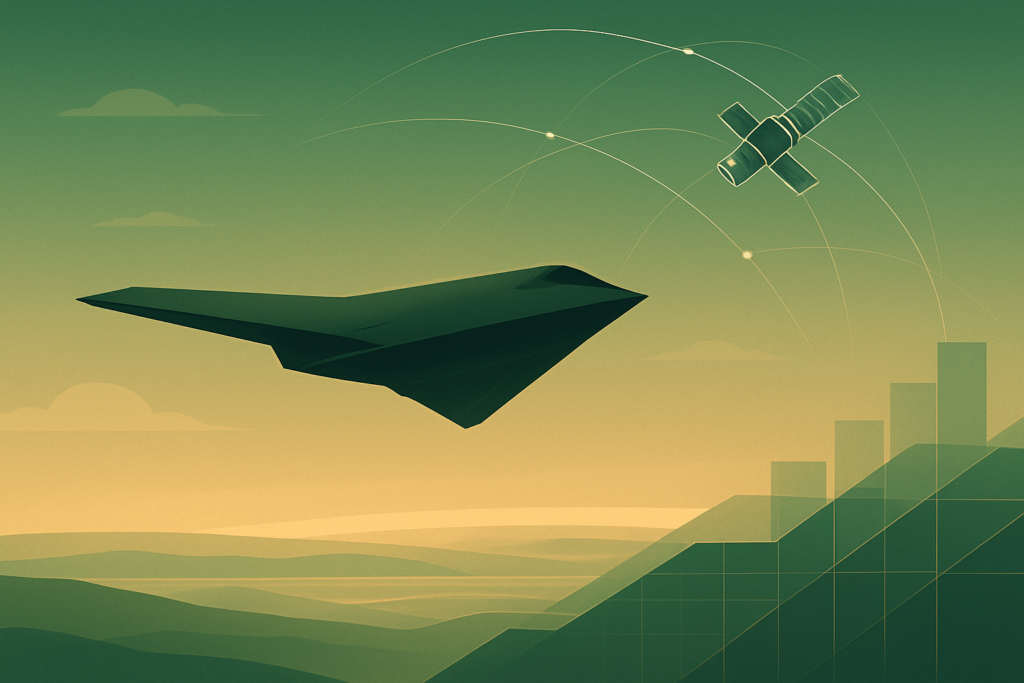
- B-21 Raider: The world’s first sixth-generation aircraft. It is designed to be a "digital bomber," capable of rapid software updates to counter evolving threats.
- Sentinel (LGM-35A): The replacement for the Minuteman III ICBM. Despite early cost overruns, it remains a "too-big-to-fail" program essential for the U.S. nuclear deterrent.
- Manta Ray: A massive autonomous underwater vehicle (UUV) designed for long-duration, long-range missions in ocean environments, representing the future of naval warfare.
- Glide Phase Interceptor (GPI): A cutting-edge system designed to shoot down hypersonic missiles during their most vulnerable phase of flight.
Competitive Landscape
Northrop Grumman operates within the "Big Five" of the U.S. defense industry, competing with Lockheed Martin (NYSE: LMT), RTX Corporation (NYSE: RTX), General Dynamics (NYSE: GD), and Boeing (NYSE: BA).
- Vs. Lockheed Martin: While Lockheed dominates tactical fighters (F-35), Northrop has secured the dominant position in strategic bombers (B-21) and next-gen ICBMs.
- Vs. RTX: RTX is a leader in munitions and missile defense (Patriot), but Northrop’s expertise in space sensors and propulsion gives it an edge in the emerging "orbital defense" market.
- Vs. Boeing: Northrop has successfully avoided the high-profile quality control issues that have plagued Boeing’s defense and commercial divisions, allowing NOC to capture market share in autonomous systems.
Industry and Market Trends
The defense industry in 2026 is defined by three major trends:
- Modernization of the Nuclear Triad: All three legs of the U.S. nuclear deterrent are being replaced simultaneously, a trillion-dollar endeavor that provides decades of work for Northrop.
- Space as a Warfighting Domain: The militarization of low-earth orbit (LEO) has led to a surge in demand for small-satellite constellations and space-based tracking systems.
- NATO Rearmament: European allies are targeting defense spending of 5% of GDP by 2035, creating a massive export market for U.S.-made advanced electronics and missiles.
Risks and Challenges
Despite the bullish outlook, Northrop Grumman faces several critical risks:
- The Sentinel Nunn-McCurdy Breach: The ICBM program saw an 81% cost jump in 2024. While the program was certified to continue, any further cost overruns could lead to political pressure to scale back or cancel components.
- Fixed-Price Contract Pressure: High inflation and supply chain delays in 2024-2025 squeezed margins on fixed-price contracts like the B-21 LRIP phases.
- Free Cash Flow (FCF) Compression: Massive capital expenditures required for production facilities have temporarily lowered FCF, which some analysts worry could limit dividend growth in the short term.
Opportunities and Catalysts
- International SHIELD Participation: If the U.S. "Golden Dome" initiative is exported to Pacific and European allies, it could represent a multi-decade revenue stream.
- B-21 Production Ramp: The U.S. Air Force has hinted at increasing its total buy of B-21s from 100 to 150 or more. Each additional aircraft adds billions in long-term revenue.
- AI and Autonomous Systems: Northrop’s lead in AI-driven "loyal wingman" drones and underwater UUVs positions it perfectly for the DoD’s Replicator initiative.
Investor Sentiment and Analyst Coverage
Wall Street maintains a "Moderate Buy" consensus on NOC as of January 2026. Major institutional holders, including Vanguard and BlackRock, have maintained or increased their positions, viewing the company as a "geopolitical hedge." Analysts emphasize that while the P/E ratio (currently around 21x forward earnings) is higher than the historical average, it is justified by the unprecedented visibility of the company’s revenue through the 2030s.
Regulatory, Policy, and Geopolitical Factors
The regulatory environment remains complex. Northrop must comply with strict ITAR (International Traffic in Arms Regulations), which can slow international sales. However, the current geopolitical climate—marked by persistent tensions in Eastern Europe and the Indo-Pacific—has created a "policy tailwind." The proposed $1.5 trillion U.S. defense budget for 2027, if passed, would provide a significant boost to Northrop's Space and Mission Systems segments.
Conclusion
Northrop Grumman enters 2026 as a formidable force in the global defense sector. Its transition from a developer of secretive prototypes to a high-volume producer of the world’s most advanced stealth and missile systems has fundamentally changed its financial profile. While the costs and complexities of the Sentinel program remain a shadow on the balance sheet, the "raised sales forecast" reflects a reality where global demand for high-end deterrence is at an all-time high. For investors, Northrop Grumman represents a play on technological superiority and long-term geopolitical stability, albeit one that requires patience as the company navigates a period of heavy capital investment.
This content is intended for informational purposes only and is not financial advice.