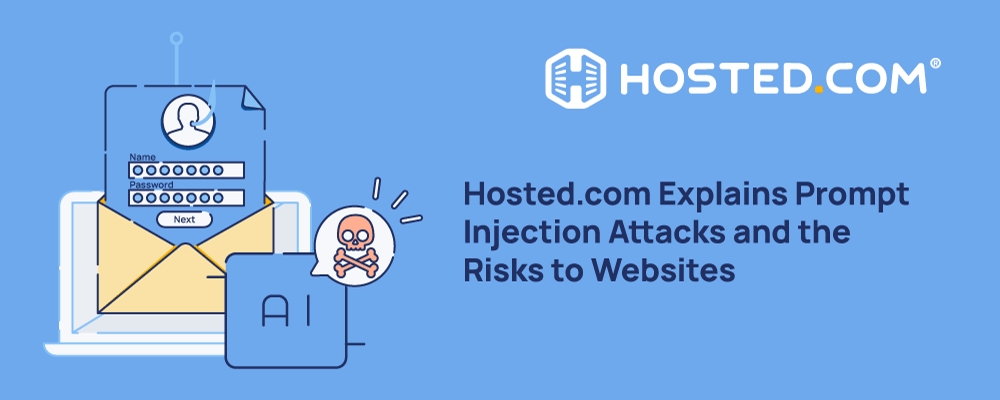
Hosted.com Explains Prompt Injection Attacks and The Risks to Websites
Hosted.com has released an in-depth article analyzing the increasing prevalence of prompt injection attacks and their impact on businesses using Artificial Intelligence (AI) for their websites and backend systems. It outlines how these attacks work, the risks they present to customer data and site stability, and the security measures used to reduce exposure.
Prompt injection attacks embed malicious prompts into user inputs or external data sources, such as email attachments or website links, that Large Language Models (LLMs) then process and execute. These prompts can cause AI systems to bypass their built-in safety guardrails, potentially exposing sensitive data, enabling unauthorized website activity, facilitating phishing attempts, or disrupting business operations entirely.
The increasing use of AI tools for customer communication, automation, analytics, and content generation has expanded the potential attack surface for online businesses. As AI systems increasingly interact with User-Generated Content (UGC), input fields, files, and databases, attackers are exploiting these gaps to influence AI model behavior to affect websites and user accounts in ways not previously possible with traditional cyberthreats and vulnerabilities.
The article identifies several different risks associated with prompt injection attacks. These include compromised data and theft, lost customer trust following security breaches, and service interruptions caused by AI-driven workflow manipulation. For businesses that regularly use AI tools and agents to process sensitive information, the consequences of these attacks can extend beyond technical issues to legal repercussions and long-lasting reputational damage.
Hosted.com also explains common mitigation approaches used in Web Hosting infrastructure. These include server-level file scanning, behavioral analysis of scripts during execution, and request filtering to identify suspicious patterns before they reach hosted websites. Such measures are intended to detect harmful activity early and prevent manipulated inputs from being processed by AI systems before they can spread and cause damage.
Web Application Firewalls (WAFs) can also provide an additional layer of protection. By filtering inbound traffic and blocking anomalous requests, these tools can reduce the chances that harmful content stored on a website will later be accessed by AI tools and used to gain access to accounts and admin dashboards. This is frequently done via comment sections, forms, and file upload areas that act as entry points for malicious inputs when they are insufficiently monitored.
When it comes to prevention, server-level website isolation, using tools such as CageFS, as used by Hosted.com, helps limit the range of possible AI-based cyberattacks caused by malicious prompts. This software helps hosting providers reduce the likelihood that a compromised file or script on one website may affect others on the same server.
Wayne Diamond, CEO of Hosted.com, commented: “From a customer perspective, one of the biggest impacts of prompt injection attacks, in addition to data theft and downtime, is the loss of confidence in the tools they rely on every day. Businesses of all sizes use AI to improve efficiency and service, but customers expect those tools to handle their data responsibly. Identifying these risks and putting safeguards in place helps protect both data and the people who rely on AI to make their lives easier.”
Alongside infrastructure protections, following best practices for safely using AI tools is essential. These include restricting permissions to only necessary files and functions, reviewing and cleaning UGC before processing, maintaining human oversight for sensitive processes, and monitoring for unusual activity that could indicate an attack attempt or website tampering.
While prompt injection attacks are difficult to eliminate entirely, awareness and layered security can reduce their likelihood and impact. Hosted.com emphasizes the importance of ongoing monitoring of AI threats and regularly updating security as new attacks emerge.
About Hosted.com
Hosted.com delivers secure, high-performance Web and WordPress hosting, and domain registration services. With a focus on speed, reliability, affordability and customer support, the company provides scalable infrastructure to meet businesses' evolving needs.
About Wayne Diamond
Wayne Diamond, founder and CEO of Hosted.com, has over 25 years of experience in the domain and web hosting industry. His leadership emphasizes clarity, accessibility, and innovation in how businesses approach website and domain management.
Media Contact
Company Name: Hosted.com
Contact Person: Wayne Diamond
Email: Send Email
Country: United States
Website: https://hosted.com