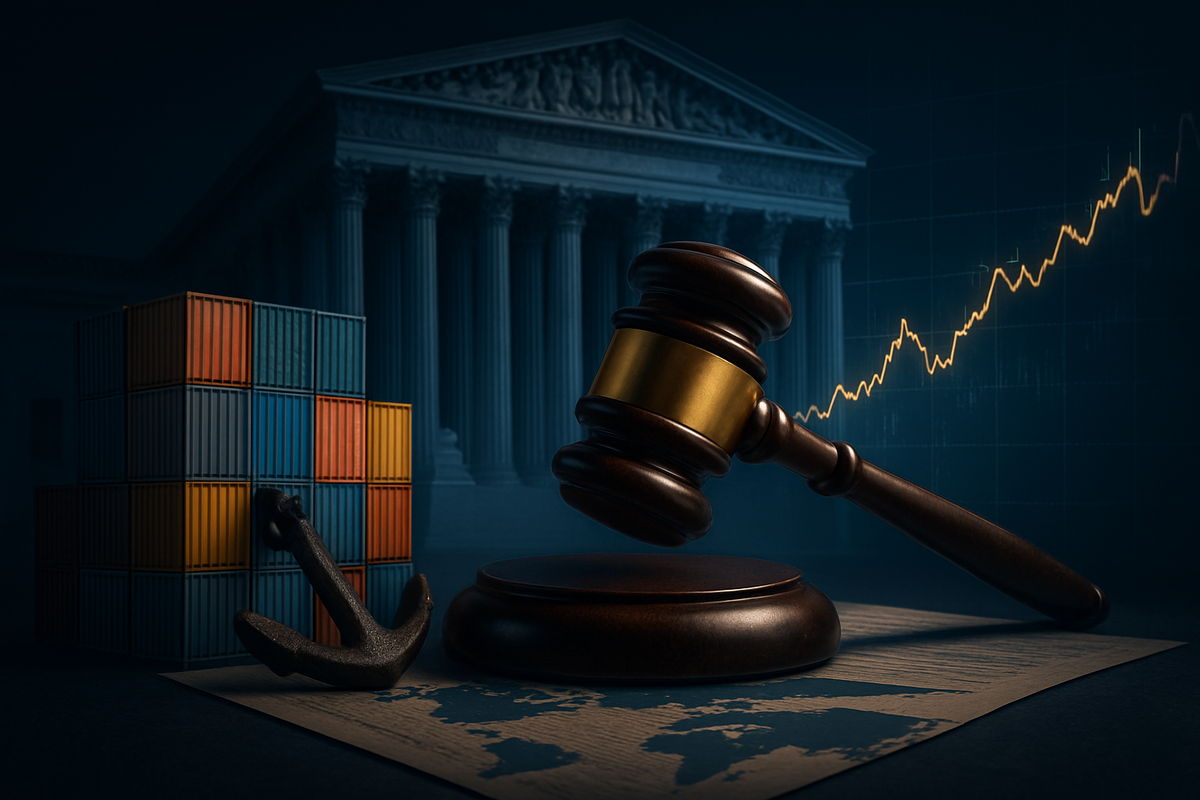
As the calendar turns to mid-January 2026, the global trade landscape sits on the precipice of a seismic shift. The U.S. Supreme Court is currently deliberating on a series of landmark cases that could fundamentally strip the executive branch of its power to unilaterally impose sweeping tariffs. At the heart of the storm is the consolidated case of Learning Resources, Inc. v. Trump, which challenges the use of emergency statutes to bypass Congressional oversight. With a ruling expected any day, the decision looms over multi-billion dollar supply chains and the pricing strategies of the world's largest corporations.
The immediate implications are staggering. If the Court rules against the administration, it could trigger a "tariff holiday," effectively nullifying duties ranging from 10% to 50% that were implemented throughout 2025. For sectors like industrials and consumer discretionary, the stakes involve not just future costs, but the potential for over $150 billion in duty refunds. Conversely, a ruling in favor of the executive would cement a new era of protectionism, leaving importers with little recourse but to pass historic costs onto a weary public.
The Legal Gauntlet: From IEEPA to the Highest Court
The current legal crisis stems from the administration’s aggressive use of the International Emergency Economic Powers Act (IEEPA) in early 2025 to enact "Reciprocal Tariffs" on a wide array of goods. While the IEEPA was originally designed to freeze assets of foreign adversaries during national emergencies, the administration repurposed it to "regulate" imports via taxation—a power traditionally reserved for Congress under Article I of the Constitution. The legal challenge, led by Learning Resources, Inc. and supported by dozens of trade groups, argues that the President’s authority to regulate commerce does not include the power to "lay and collect" duties without explicit legislative approval.
The timeline leading to this moment has been marked by rapid escalation. Following the 2025 tariff announcements, lower courts, including the Court of International Trade and the Federal Circuit, issued a series of conflicting rulings that eventually forced the Supreme Court's hand. Oral arguments were heard on November 5, 2025, where several Justices expressed skepticism regarding the "limitless" nature of executive emergency powers. The timing of the case is critical; it follows the 2024 overturn of the Chevron deference in Loper Bright Enterprises v. Raimondo, a move that significantly weakened the ability of federal agencies to interpret ambiguous statutes in their own favor.
Key stakeholders, from the U.S. Trade Representative (USTR) to the Department of Commerce, find themselves in a defensive posture for the first time in decades. For years, the executive branch relied on broad interpretations of Section 232 (national security) and Section 301 (unfair trade practices) to manage trade policy. However, the current Supreme Court has signaled a preference for the "Major Questions Doctrine," which posits that any policy with "vast economic and political significance" must be backed by clear, unambiguous language from Congress. Without such language in the IEEPA, the administration’s trade architecture is currently standing on a crumbling legal foundation.
Winners and Losers: A Market Divided by Border Taxes
The ripple effects of a potential Supreme Court strike-down of tariffs would create immediate winners and losers across the New York Stock Exchange and NASDAQ. Among the most anticipated "winners" are major retailers who have been forced to eat the costs of the 2025 duties to maintain market share. Companies such as Costco Wholesale Corporation (NASDAQ: COST), Target Corporation (NYSE: TGT), and Amazon.com, Inc. (NASDAQ: AMZN) have seen their margins squeezed by import duties on everything from electronics to apparel. A ruling against the tariffs could result in a massive windfall of duty refunds, providing these consumer discretionary giants with a sudden influx of capital for dividends or reinvestment.
On the other side of the ledger, domestic material producers face significant downside risk. U.S. steel and aluminum manufacturers have been the primary beneficiaries of protectionist policies. For companies like United States Steel Corporation (NYSE: X) and Nucor Corporation (NYSE: NUE), the 50% duties on foreign competitors have allowed them to maintain high domestic prices and robust margins. If the Supreme Court removes these protections, these stocks could face a sharp correction as they are forced to compete once again with cheaper global imports.
The industrial and automotive sectors are caught in a more complex bind. Heavy machinery manufacturers like Caterpillar Inc. (NYSE: CAT) and automotive leaders like General Motors (NYSE: GM) and Ford Motor Company (NYSE: F) have struggled with "the highest material costs in a decade." While these firms might benefit from lower input costs if tariffs are removed, the resulting "policy whiplash" and supply chain volatility could disrupt production schedules for months. Investors are currently closely monitoring the 10-K filings of these firms, searching for "tariff contingency" language that indicates how prepared management is for a sudden change in the trade regime.
A Post-Chevron Era for Global Trade
The significance of this legal battle extends far beyond the immediate price of steel or sneakers. It marks the first major test of trade policy in the post-Chevron era. For half a century, the U.S. government has operated under the assumption that if a trade law was vague, the executive branch had the right to fill in the blanks. That era is over. By applying the "Major Questions Doctrine" to trade, the Supreme Court is essentially telling the President that they can no longer use 20th-century national security laws to wage 21st-century trade wars without a fresh mandate from Capitol Hill.
This shift mirrors broader industry trends toward "near-shoring" and "friend-shoring," but with a legal twist. If the President’s emergency powers are curtailed, the administration may be forced to rely more heavily on bilateral treaties and formal trade agreements—processes that are notoriously slow and politically fraught. This could lead to a more stable, albeit less flexible, trade environment. Historically, this level of judicial intervention in foreign economic policy is rare, drawing comparisons to the "sick chicken" case of the 1930s that dismantled parts of the New Deal, signaling a potential rollback of executive overreach that has been growing since the Cold War.
Furthermore, the regulatory implications are profound. A loss for the administration would likely lead to a surge in private litigation. Thousands of smaller companies that did not join the initial lawsuits may file their own claims for "me-too" refunds, overwhelming the Court of International Trade. This would create a regulatory backlog that could take years to clear, creating a permanent state of uncertainty for any company that relies on international logistics.
The "Tariff Holiday" and the Search for Plan B
As the market enters late January 2026, the short-term outlook is dominated by "planning paralysis." The National Retail Federation has already reported a 3.4% decline in cargo volumes as importers wait for the Supreme Court's word before committing to long-term shipping contracts. If the Court strikes down the tariffs, we may witness a "tariff holiday"—a brief window where goods flow into the U.S. duty-free while the administration scrambles to find a legal "Plan B."
The strategic pivot for the White House would likely involve launching new, more formal investigations under Section 301 or Section 232. Unlike the emergency actions taken in 2025, these processes require public comment periods and rigorous economic impact studies, which could take nine months or more to complete. This window could provide a temporary boost to sectors sensitive to inflation, but it also invites a period of extreme market volatility as traders speculate on which products will be back on the "hit list" by late 2026.
In the long term, the outcome of these rulings will likely force a reorganization of supply chain management. Companies will need to move away from "just-in-time" inventory and toward "just-in-case" legal strategies, diversifying their sourcing not just by geography, but by the specific legal statutes that govern their imports. The era of assuming a President can change the price of global trade with a single executive order appears to be coming to an end, replaced by a more litigious and process-driven environment.
Summary and Investor Outlook
The impending Supreme Court rulings on tariff authority represent a watershed moment for the U.S. economy. For over a year, the markets have operated under a cloud of executive-driven protectionism; now, the judicial branch is poised to decide if that cloud will dissipate or turn into a permanent storm. The key takeaways for investors are clear: a ruling against the administration will likely favor large-cap retailers and tech hardware importers while putting immediate pressure on domestic industrial producers who have relied on high-duty walls.
Moving forward, the market will likely experience heightened sensitivity to any communication from the Supreme Court. Investors should watch for the "Learning Resources" decision as the primary catalyst for 2026's first major market rotation. Beyond the immediate stock price movements, the lasting impact will be a re-assertion of Congressional power over the nation's purse strings. As the executive branch loses its "emergency" shortcuts, the path to trade policy will once again lead through the halls of Congress—a prospect that promises more transparency, but also more political gridlock, for the foreseeable future.
This content is intended for informational purposes only and is not financial advice