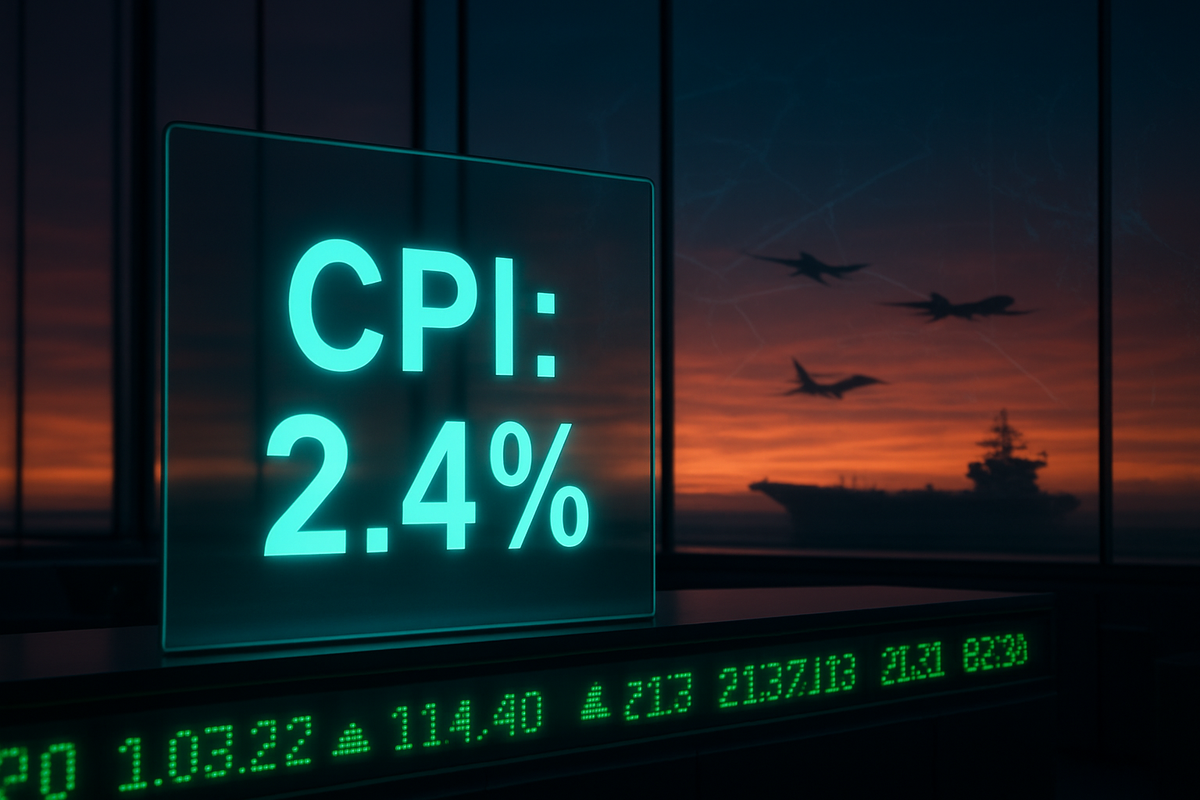
The U.S. Bureau of Labor Statistics released the February Consumer Price Index (CPI) report on the morning of March 11, 2026, revealing that headline inflation held steady at an annual rate of 2.4%. This figure matched both the previous month's data and economist expectations, signaling a hard-won plateau in the Federal Reserve’s long-standing battle against post-pandemic price surges. For a brief moment, the data provided a "welcome distraction" for a global market that has spent the last several weeks fixated on the sudden and violent escalation of military conflict in the Middle East.
While the 2.4% reading suggests that domestic price pressures were cooling through February, the relief felt by investors was tempered by the reality that this data is largely backward-looking. As the SPDR S&P 500 ETF Trust (NYSEARCA: SPY) saw a marginal bump in early morning trading, analysts warned that the stability reflected in this report does not yet account for the massive energy shock triggered by "Operation Epic Fury," the U.S.-led military campaign against Iran that began in late February. The report offers a snapshot of an economy that was finding its footing just as the geopolitical ground began to shift.
A Snapshot of Stability Amidst Growing Chaos
The February CPI report showed a headline inflation rate of 2.4% year-over-year, while Core CPI—which strips out the more volatile categories of food and energy—remained consistent at 2.5%. On a monthly basis, prices rose 0.3%, a slight acceleration from the 0.2% increase seen in January. Shelter costs remained the most stubborn component of the index, rising 3.0% annually and serving as the primary driver of the monthly headline increase. Food prices also showed signs of heat, particularly in the grocery aisle, where beef and veal prices jumped 1.5% in February alone.
The timeline leading up to this release has been one of extreme volatility. Throughout late 2025 and the start of 2026, the Federal Reserve, currently maintaining the federal funds rate at 3.50%–3.75%, had been signaling a potential shift toward rate cuts. However, the onset of major hostilities in the Middle East in late February sent the CBOE Volatility Index (VIX) into a tailspin. By the time today's report was released, oil prices had already begun to climb in the spot market, even though the February data showed energy prices up only 0.5% over the last 12 months. This lag in data collection means that the "inflationary fire" of the current war has not yet been reflected in the official government statistics.
Key stakeholders, including Federal Reserve officials and Treasury Secretary Janet Yellen, have characterized the 2.4% figure as a sign of economic resilience. However, the FOMC remains deeply divided. Before the outbreak of the Iran conflict, the market had priced in a 25-basis-point cut for the March meeting. Following the release of this report and the ongoing military operations, those expectations have largely evaporated, as the Fed shifts its focus toward preventing a secondary inflationary spike caused by disrupted global supply chains and high energy costs.
Sector Winners and Losers in a War-Torn Market
The intersection of stabilizing inflation and escalating war has created a stark divide in the equity markets. The primary beneficiaries of the current climate have been defense contractors and aerospace firms. Companies like Lockheed Martin (NYSE: LMT) and Northrop Grumman (NYSE: NOC) have seen their order books swell as the U.S. and its allies increase procurement for advanced munitions and surveillance systems. Furthermore, the focus on AI-driven warfare has boosted Palantir Technologies (NASDAQ: PLTR), whose data analytics platforms are increasingly integral to modern military command and control.
Conversely, the retail and consumer discretionary sectors are bracing for a "double squeeze." Major retailers like Walmart (NYSE: WMT) and Target (NYSE: TGT) are facing a scenario where the 2.4% baseline inflation is suddenly met with a sharp rise in logistical costs. While February’s gas prices were relatively low, the 20% surge in gasoline prices observed in early March—reaching a 60-cent-per-gallon jump in some regions—acts as a de facto consumption tax. This shift is expected to erode the discretionary spending power of middle-income households, potentially reversing the gains these retailers made during the holiday season.
The technology sector, led by giants such as Apple (NASDAQ: AAPL) and Microsoft (NASDAQ: MSFT), faces a more complex outlook. While these "Magnificent" firms are often viewed as safe havens during periods of uncertainty, they are not immune to "higher-for-longer" interest rates. The prospect of the Federal Reserve holding rates steady at 3.50%–3.75% to combat war-driven inflation pressures the high valuations of growth stocks. Additionally, the energy-intensive nature of AI data centers, powered by NVIDIA (NASDAQ: NVDA) hardware, means that rising electricity and cooling costs could impact the bottom line for cloud service providers in the coming quarters.
The Broader Significance: Inflation’s Second Wave?
The 2.4% inflation print is significant because it marks the closest the U.S. has come to the Federal Reserve's 2% target in years. Historically, such a reading would have been the "all-clear" signal for a pivot toward monetary easing. However, the current situation bears a haunting resemblance to the stagflationary shocks of the 1970s, where geopolitical events in the Middle East derailed domestic progress on price stability. The "welcome distraction" of today's report is essentially the eye of a hurricane—a moment of calm before the inflationary impact of the Strait of Hormuz disruption hits the domestic supply chain.
Regulatory and policy implications are also coming into focus. The Biden administration is under pressure to balance the funding of a major military campaign with the need to prevent a cost-of-living crisis ahead of the 2026 midterm elections. There is growing talk of strategic petroleum reserve releases to counter the oil price spike, a move that would directly impact energy majors like ExxonMobil (NYSE: XOM). Furthermore, the shift toward "Sovereign AI" and domestic manufacturing is accelerating as a matter of national security, suggesting that industrial policy will continue to play a larger role in the market than traditional monetary policy in the years ahead.
Looking Ahead: The Path to the Summer
In the short term, investors should prepare for a period of "data decoupling." We are likely to see several months where the CPI report shows moderate inflation, while real-time indicators like shipping rates and energy futures tell a much more aggressive story. The Federal Reserve's March 17–18 meeting will be the most critical event of the spring; a decision to hold rates steady would confirm that the Fed is more afraid of a war-driven inflation "second wave" than it is of a potential economic slowdown.
Longer-term, the strategic pivot for many companies will involve diversifying supply chains away from potential conflict zones and investing in energy efficiency. If the conflict in the Middle East is contained quickly, the 2.4% inflation rate could serve as a springboard for a massive market rally in late 2026. However, if "Operation Epic Fury" expands into a broader regional war, the market will likely have to navigate a "high-inflation, low-growth" environment that hasn't been seen in decades. Strategic adaptations in the energy sector will be paramount, as the transition to renewables may be accelerated by the need for national energy independence.
Closing Thoughts for the Modern Investor
The February CPI report is a testament to the resilience of the U.S. economy, proving that the underlying drivers of inflation were finally coming under control. However, in the fast-moving landscape of 2026, yesterday’s data is often a poor guide for tomorrow’s risks. The "welcome distraction" of a 2.4% inflation figure gave the market a morning of green screens, but the underlying anxiety regarding global conflict remains the dominant force.
Moving forward, the primary metric for investors should not just be the headline CPI, but the "War-Adjusted Inflation" expectations. As long as the Strait of Hormuz remains a flashpoint, the risk of a "re-inflation" event remains high. For the next several months, the Federal Reserve will likely remain sidelined, and the market’s trajectory will be dictated more by headlines from the Pentagon than by data from the Bureau of Labor Statistics.
This content is intended for informational purposes only and is not financial advice.