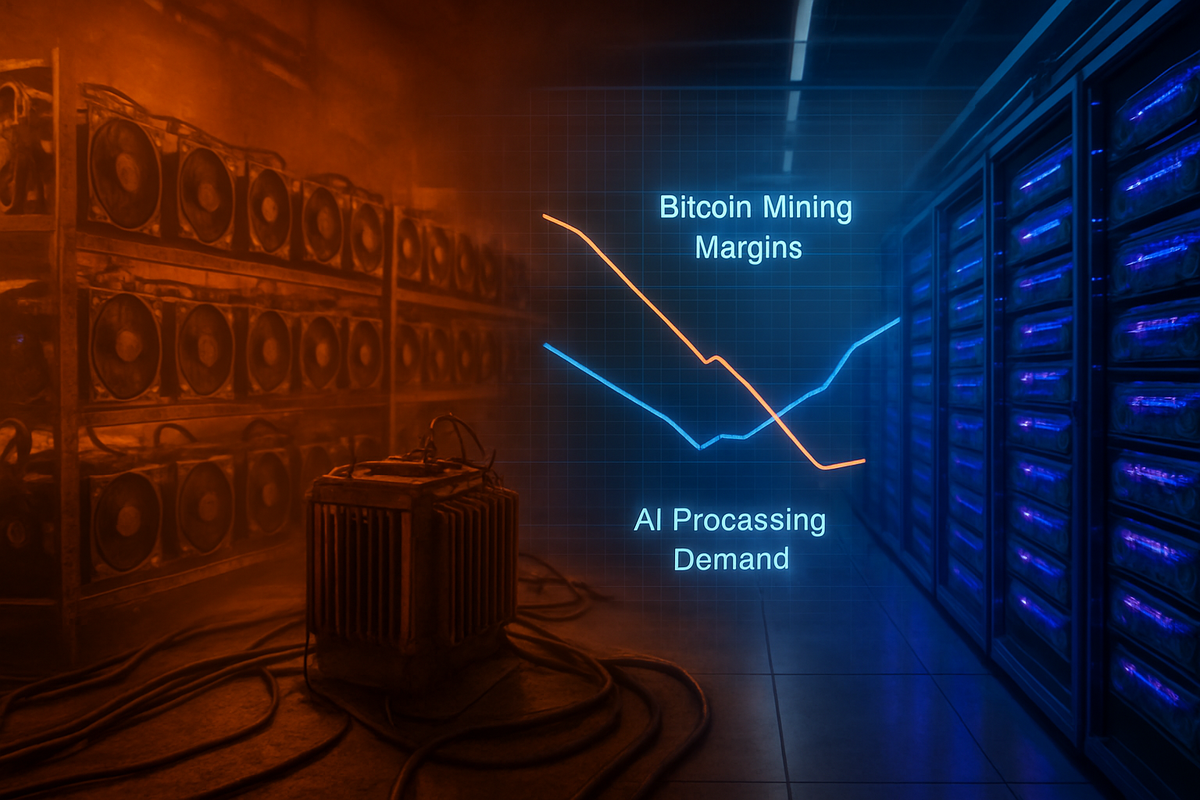
As of March 20, 2026, the landscape of digital infrastructure has reached a critical inflection point. The once-dominant titans of the Bitcoin mining industry, MARA Holdings, Inc. (NASDAQ: MARA) and Riot Platforms, Inc. (NASDAQ: RIOT), are currently grappling with a punishing "double-squeeze." The combined pressure of post-halving economics and a dramatic surge in global energy costs has forced a painful re-rating of their stocks, as investors increasingly favor companies that transitioned early into artificial intelligence (AI) and high-performance computing (HPC).
This shift represents a fundamental transformation of the sector. What was once a race to accumulate the most Bitcoin has evolved into a sophisticated game of "computational arbitrage." Companies that failed to diversify their power loads toward the high-margin AI sector throughout 2024 and 2025 are now finding themselves in a capital-intensive race to catch up, often at the expense of their balance sheets and the "HODL" strategies that once defined their identities.
The Cost of Staying "Pure-Play": A Timeline of Margin Erosion
The current struggle for MARA and Riot traces its roots back to the April 2024 Bitcoin halving, an event that slashed block rewards from 6.25 BTC to 3.125 BTC. While the industry initially hoped for a sustained price surge to offset the loss in production, the reality of 2025 proved far more complex. For Riot Platforms, the cost to mine a single Bitcoin skyrocketed from under $4,000 in early 2023 to a staggering $32,216 by the end of 2024. MARA Holdings faced even tighter margins, with production costs peaking at over $52,000 per BTC in late 2024.
Throughout 2025, external factors exacerbated these internal pressures. Geopolitical instability pushed crude oil prices toward the $100-per-barrel mark, causing industrial electricity rates to spike across North America. MARA, which had relied heavily on third-party hosting sites, saw its energy expenses consume nearly 80% of its gross revenue by mid-2025. The market reaction was swift and severe; in early 2026, major financial institutions like Morgan Stanley (NYSE: MS) downgraded the sector, explicitly citing the "untenable risk" of pure-play Bitcoin exposure compared to the steady, diversified income of data center leasing.
Winners and Losers: The Early Movers vs. The Late Rebranders
The market’s divergent performance highlights a clear set of winners: those who recognized the AI boom as a lifeline for energy-heavy infrastructure. Core Scientific, Inc. (NASDAQ: CORZ) and TeraWulf Inc. (NASDAQ: WULF) have emerged as the standard-bearers of this new era. By securing multi-billion dollar contracts with AI firms like CoreWeave as early as mid-2024, these companies locked in predictable cash flows that insulated them from Bitcoin’s volatility. TeraWulf, in particular, leveraged its "zero-carbon" mining model to appeal to ESG-conscious AI developers, leading to a valuation premium that neither MARA nor Riot has yet been able to match.
Conversely, MARA and Riot are currently in the "trough" of their transformation. MARA Holdings, formerly Marathon Digital, has been forced to break its long-standing policy of holding all mined Bitcoin. In late 2025, the company liquidated over $400 million of its BTC treasury to fund a massive 1 GW joint venture with Starwood Capital Group aimed at AI data center development. Riot Platforms has faced its own internal turmoil, with activist investors like Starboard Value pushing for a faster transition. Riot’s recent landmark agreement with Advanced Micro Devices, Inc. (NASDAQ: AMD) to repurpose its Texas facilities for AI inference represents a desperate but necessary pivot that has yet to reflect fully in its bottom line.
A Broader Shift: From Crypto Miners to Digital Energy Providers
The struggles of MARA and Riot are not isolated incidents but symptoms of a broader industry trend toward "Power-as-a-Service." In the previous cycle, the value of a mining company was tied directly to its hashrate and its Bitcoin treasury. In 2026, the new metric of success is "Power Capacity." Regulatory bodies, particularly in energy-constrained regions like Texas and New York, have become increasingly skeptical of pure Bitcoin mining, viewing it as a drain on the grid with little local economic benefit.
This regulatory pressure has accelerated the AI pivot. AI data centers are viewed by policymakers as essential infrastructure for the 21st-century economy, making it easier for companies to secure power permits and tax incentives. Historically, this mirrors the transition of the early internet service providers; those who stayed focused solely on dial-up connectivity were eventually swallowed by those who built the backbone of the broadband era. The Bitcoin miners of 2026 are finding that their true value lies not in the coins they mine, but in the gigawatts they control.
The Road Ahead: Adaptation and Survival
In the short term, investors should expect continued volatility as MARA and Riot execute their multi-billion dollar infrastructure overhauls. The "rebranding" phase is largely complete, but the "operationalization" phase—installing high-end GPUs, upgrading cooling systems, and securing long-term AI tenants—will take several more quarters. MARA’s recent report of a $1.71 billion net loss for Q4 2025, largely due to write-downs on its Bitcoin treasury, serves as a sobering reminder of the costs associated with this transition.
Long-term, the success of these companies will depend on their ability to manage a "hybrid" model. The most resilient firms will likely be those that can switch their power usage between Bitcoin mining and AI processing in real-time, depending on which is more profitable at any given moment. This "computational arbitrage" strategy could provide a floor for valuations that was previously absent. However, the barrier to entry is rising; the cost of AI hardware is significantly higher than that of Bitcoin ASICs, requiring a level of capital access that will likely lead to further consolidation in the industry.
Summary and Investor Outlook
The narrative of "Crypto Miners Struggle" is effectively a story of an industry outgrowing its original niche. The key takeaways for the market in March 2026 are clear: pure-play mining is no longer a viable long-term strategy in a high-energy-cost environment. MARA Holdings and Riot Platforms are currently paying the price for their delayed entry into the AI sector, but their massive power footprints still provide them with a "path to redemption" if they can execute their current pivots.
Moving forward, the market will be watching for more than just hashrate updates. Investors should keep a close eye on power-use-effectiveness (PUE) metrics, the progress of GPU installations, and any further liquidations of Bitcoin treasuries to fund capital expenditures. While the "golden age" of easy Bitcoin mining may be over, the era of the "Digital Energy Giant" is just beginning.
This content is intended for informational purposes only and is not financial advice.