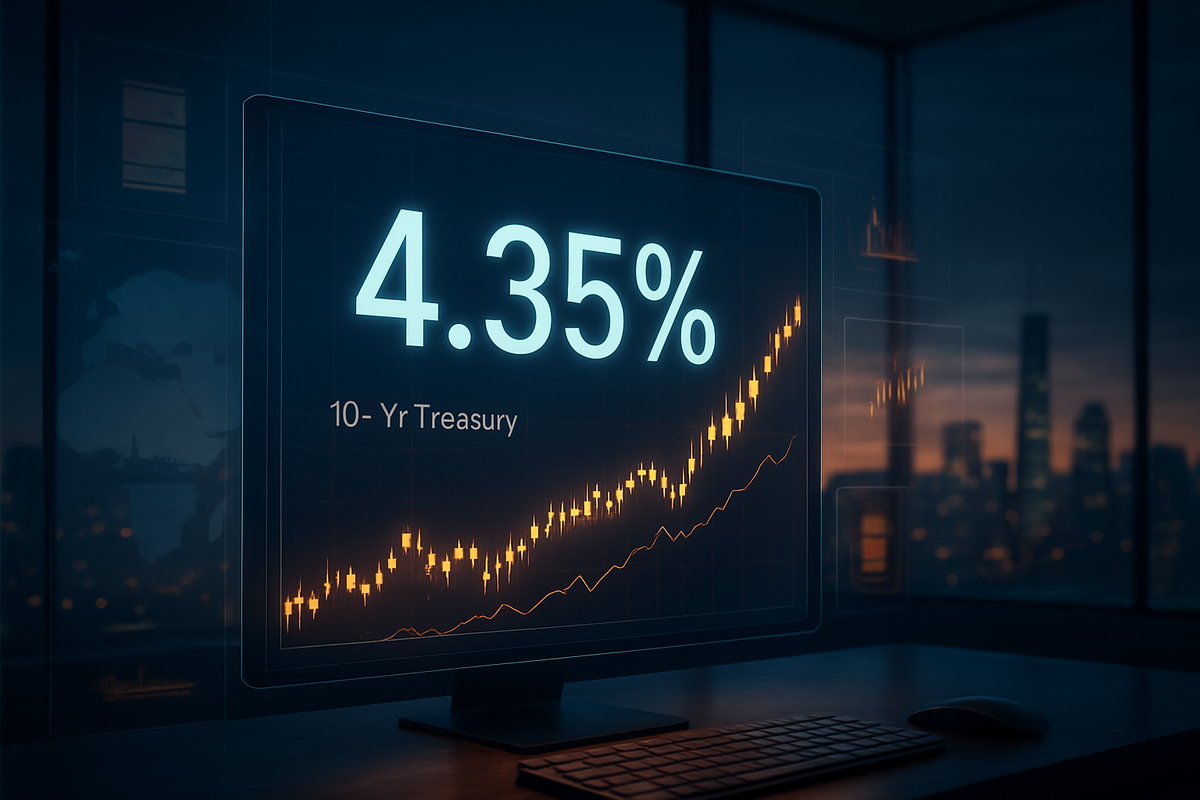
As of April 6, 2026, the global financial landscape is grappling with a stark new reality: the 10-year U.S. Treasury yield has anchored itself at 4.35%, a level that just months ago seemed like a worst-case scenario. This psychological and technical threshold has sent ripples through the fixed-income markets, as investors pivot from a "lower-for-longer" hope to a "higher-for-uncertain" defensive posture. The catalyst for this shift is a volatile cocktail of stubborn services sector inflation and a geopolitical landscape that has grown increasingly perilous.
The immediate implications are profound. Borrowing costs for corporations are surging just as the "AI debt binge" reaches its zenith, and the traditional 60/40 portfolio is once again being tested by the correlation of falling bond prices and equity market jitters. With the Federal Reserve signaling that rate cuts are essentially off the table for the first half of the year, fixed-income investors are recalibrating their expectations, focusing on quality and duration management to weather a potential stagflationary storm.
The Perfect Storm: Services Inflation and Geopolitical Tensions
The journey to a 4.35% 10-year yield was catalyzed by a "blockbuster" March employment report and a shocking resurgence in services sector costs. The ISM Services Prices Paid Index, a key barometer for inflation in the largest part of the U.S. economy, surged to 70.7% in March—its highest reading since late 2022. This 7.7-percentage point jump in a single month caught the market off guard, signaling that while goods inflation may have cooled, the services sector remains a hotbed of price pressures, largely driven by energy costs and logistics.
Parallel to these economic headwinds is the escalating "Operation Epic Fury" conflict involving Iran. The effective closure of the Strait of Hormuz has sent crude oil prices—specifically West Texas Intermediate (WTI)—soaring past $110 per barrel. This energy shock has a direct pass-through effect on the services sector, increasing costs for everything from air travel to warehouse management. Consequently, the "inflationary floor" appears much higher than the Fed’s 2% target, forcing yields upward as bondholders demand more compensation for future purchasing power erosion.
Timeline of the current volatility began in February when the 10-year yield sat at a relatively modest 3.97%. However, as geopolitical tensions flared in the Middle East and the U.S. announced a staggering $1.5 trillion military budget proposal—a 44% increase aimed at regional stabilization—concerns over a massive oversupply of Treasuries took hold. By late March, the yield spiked to 4.48% before retreating slightly to today’s 4.35% mark. Market participants, led by heavyweights like JPMorgan Chase & Co. (NYSE: JPM), have largely accepted that the "cheap money" era is not returning anytime soon.
The reaction from institutional desks has been one of "aggressive caution." The CME FedWatch Tool now shows a 94.8% probability that the Federal Reserve will hold rates steady during its upcoming late-April meeting. This consensus reflects a total abandonment of the early-year optimism that predicted multiple rate cuts. Instead, the focus has shifted to the yield curve's "choppiness," where the 30-year Treasury is nearing the 5% mark, signaling long-term fears about U.S. fiscal sustainability and persistent inflation.
Winners and Losers in the 4.35% Era
In this environment, the divide between the "haves" and "have-nots" of the corporate world is widening. Financial giants like BlackRock, Inc. (NYSE: BLK) are finding unique opportunities amidst the chaos. Rick Rieder, BlackRock’s Chief Investment Officer of Global Fixed Income, has characterized these high yields as a "generational opportunity" for those willing to move "up-in-quality." By pivoting toward securitized assets and European sovereigns, asset managers are finding ways to capture yield while mitigating the duration risk that currently plagues long-term U.S. Treasuries.
Conversely, the tech sector is facing a significant challenge. For years, companies like Alphabet Inc. (NASDAQ: GOOGL) and Amazon.com, Inc. (NASDAQ: AMZN) operated with massive cash piles that shielded them from rate hikes. However, the 2026 AI infrastructure race has forced these giants into a record-breaking "AI debt binge." Amazon is currently seeking roughly $37 billion in bond sales to fund AWS infrastructure, while Alphabet recently executed a landmark $32 billion debt raise, which remarkably included a rare 100-year bond. At 4.35%, the cost of servicing this "AI debt" is becoming a significant drag on earnings projections.
Other losers in this landscape include high-growth, high-multiple firms like NVIDIA Corporation (NASDAQ: NVDA) and Meta Platforms, Inc. (NASDAQ: META). While their operational growth remains strong, their valuations are sensitive to the discount rates applied to future cash flows. As the 10-year yield stays elevated, the "present value" of those future earnings shrinks, leading to the "capex anxiety" currently visible in their stock performance. Furthermore, real estate investment trusts like Prologis, Inc. (NYSE: PLD) are feeling the squeeze as the cost of refinancing their massive logistics portfolios climbs in tandem with Treasury benchmarks.
On the winning side, commercial banks like JPMorgan Chase & Co. (NYSE: JPM) may benefit from expanded net interest margins, provided the economy avoids a deep recession. Jamie Dimon, CEO of JPMorgan, has been vocal about the potential for "stagflation," yet the bank’s strategy of emphasizing short-duration funds has allowed it to remain nimble. Energy companies are also reaping the rewards of $110 oil, providing a natural hedge for investors who are overweight in the sector to offset bond market losses.
Wider Significance and Historical Precedents
The current state of the bond market represents more than just a temporary spike; it is a fundamental shift in the global macro regime. We are seeing a move away from the post-2008 era of "financial repression" and toward a world where capital has a significant cost. This fits into the broader industry trend of "reshoring" and "re-arming," as Western nations prioritize security and supply chain resilience over pure cost efficiency. The proposed $1.5 trillion U.S. military budget is a testament to this shift, signaling that fiscal deficits will likely remain high regardless of the interest rate environment.
The ripple effects are being felt by international partners. The eurozone is currently facing a deeper growth drag than the U.S., with analysts predicting a 2-3% slowdown as energy costs cripple industrial output. This creates a divergence where the U.S. dollar remains dominant, further squeezing emerging markets that carry dollar-denominated debt. Regulators at the Fed and the SEC are closely watching the "crowding out" effect, where massive corporate bond issuances from the likes of Microsoft Corporation (NASDAQ: MSFT) are competing directly with Treasuries for investor dollars.
Historically, this period draws comparisons to the late 1970s and early 1980s, where geopolitical shocks (the Iranian Revolution) combined with sticky inflation forced a radical rethinking of monetary policy. While the current Fed has not yet reached the "Volcker moment" of 20% rates, the 4.35% yield on the 10-year suggests that the "neutral rate" (R-star) may be much higher than previously thought. This historical precedent suggests that investors who wait for a return to 2% yields may be waiting for a ghost that no longer haunts the halls of the Eccles Building.
Furthermore, the "AI debt binge" represents a new variable in market history. Never before has a technological shift required such vast amounts of capital in such a short window during a high-interest-rate environment. This creates a unique structural pressure on yields; even if inflation were to cool, the sheer volume of bond supply from both the U.S. Treasury and Big Tech could keep yields elevated through a purely supply-and-demand mechanism.
What Comes Next: Strategic Pivots and Scenarios
In the short term, the market is likely to remain in a "holding pattern" of high volatility until there is clarity on the Strait of Hormuz. If the conflict de-escalates, we could see the 10-year yield moderate back toward the 4.00% mark as the energy-driven component of services inflation recedes. However, if "Operation Epic Fury" expands into a broader regional conflict, analysts at Trading Economics warn that the 10-year could quickly breach 4.50% and head toward 5.00%, a level not seen in decades.
Strategically, corporations will need to pivot from aggressive expansion to "capital discipline." We may see a slowdown in the AI infrastructure race as the cost of debt begins to outweigh the speculative returns on AI software. For fixed-income investors, the strategy of "barbelling"—holding very short-term cash equivalents and very long-term high-quality corporates—may become the standard for navigating this period of "dispersion," as identified by BlackRock.
Potential scenarios for the latter half of 2026 include a "soft landing" where inflation slowly drifts down while rates remain high, or a "hard landing" triggered by the sudden tightening of credit conditions. The risk of a "policy error" by the Fed remains elevated; if they hold rates too high for too long in the face of a services shock, they risk breaking the labor market, which has so far remained surprisingly resilient.
Closing Thoughts: The New Macro Reality
The 4.35% 10-year Treasury yield is more than just a number; it is a signal that the global economy has entered a new, more expensive chapter. The combination of persistent services inflation and acute geopolitical risk has created a "floor" for interest rates that few anticipated two years ago. Investors must now operate in a world where "risk-free" returns are high, but the risks themselves—geopolitical, fiscal, and inflationary—are equally daunting.
As we move forward into the summer of 2026, the key takeaways are clear: inflation is no longer a "transitory" goods problem but a structural services challenge; geopolitical events are now primary drivers of fixed-income volatility; and even the world's most powerful tech companies are not immune to the rising cost of capital. The "higher-for-longer" narrative has evolved into a "higher-forever?" question that will dominate boardrooms and trading desks for the foreseeable future.
Investors should closely monitor the monthly ISM Services reports and crude oil price action. Any signs of a cooling labor market combined with sustained high yields could be the precursor to the stagflation that Jamie Dimon has warned of. In this environment, the bond market is no longer a "boring" haven of stability but the front line of a global economic transformation.
This content is intended for informational purposes only and is not financial advice