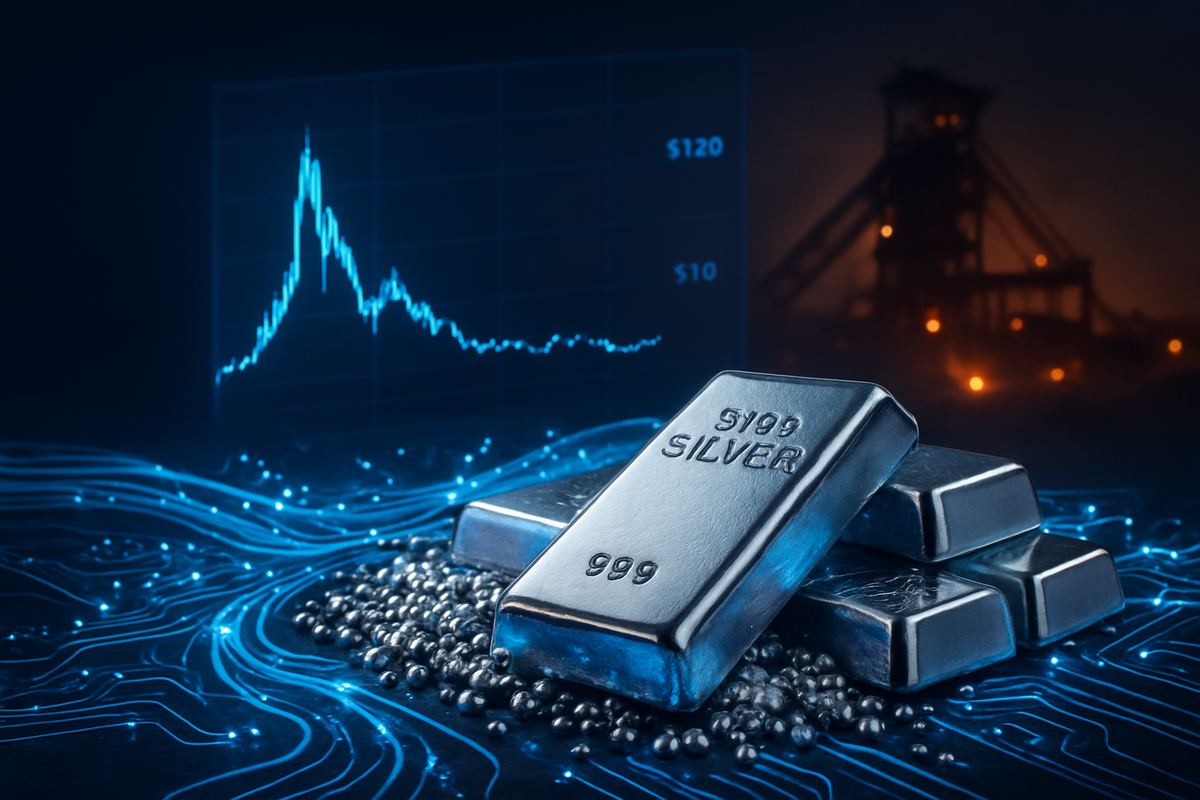
NEW YORK — As of April 7, 2026, the global silver market is attempting to find its footing following one of the most volatile quarters in commodity history. After a parabolic surge saw the metal touch an intraday all-time high of $121.67 on January 29, 2026, a sharp correction has brought prices back to a current range of $70 to $72. While this represents a nearly 40% retreat from the winter peak, the current price levels remain a staggering 140% higher than where silver began 2025, signaling a permanent regime shift for the "white metal" from a forgotten monetary asset to a critical strategic industrial material.
This "fragile recovery" is currently caught in a tug-of-war between two powerful forces. On one side, a deep-seated structural deficit—now entering its sixth consecutive year—and insatiable demand from the artificial intelligence (AI) and green energy sectors provide a robust long-term floor. On the other, immediate pressures from energy-driven supply disruptions and China’s recent move to restrict silver exports as a "dual-use strategic material" have created a landscape of uncertainty that is testing the nerves of both industrial end-users and retail investors.
The January Peak and the Road to $70
The timeline leading to the current $70 range began in late 2025, when a confluence of record-low exchange inventories and a massive retail short squeeze in Asian markets sent silver prices into a vertical climb. By the end of January 2026, the market hit the historic $121.67 mark, driven by reports that industrial stockpiles at the COMEX and LBMA had fallen to their lowest levels in 40 years. However, the peak proved unsustainable as the Chicago Mercantile Exchange (CME) implemented three consecutive margin hikes in early February, forcing over-leveraged traders to liquidate positions.
The correction was further exacerbated by the nomination of a more hawkish Federal Reserve leadership, which temporarily bolstered the dollar. By mid-February, silver had plummeted to a low of $64 before stabilizing in the current $70–$72 corridor. Market analysts now view this "consolidation phase" as a healthy reset. Unlike previous boom-and-bust cycles, the current price floor is supported by the physical reality of a market that has accumulated a deficit of nearly 900 million ounces since 2021—roughly equivalent to an entire year of global mine production.
Corporate Winners and the Burden of Cost
The dramatic price action has created a divergent landscape for the companies tasked with pulling the metal out of the ground. First Majestic Silver (NYSE: AG) has emerged as a focal point for investors, having reported a record 2025 production of 15.4 million ounces. While the company has benefited from the price surge, its 2026 guidance of 13–14 million ounces reflects the operational challenges facing the industry. First Majestic’s strategic acquisition of the Gatos project has positioned it as a dominant player, yet its stock performance remains sensitive to the All-In Sustaining Costs (AISC), which have risen across the sector by 25% over the past year due to energy inflation.
Other key players are also navigating this high-stakes environment. Hecla Mining (NYSE: HL) has rebranded itself as the "Silver Standard" after divesting its gold-heavy assets to focus on pure-play silver production. Its stock, which surged 300% in 2025, is now consolidating alongside the metal's price. Meanwhile, Pan American Silver (NYSE: PAAS) continues to benefit from the successful integration of its Juanicipio mine, guiding for 25–27 million ounces in 2026. However, even these giants are feeling the pinch of "concentrate shortages." Because 70% of silver is a byproduct of lead, zinc, and copper mining, these companies cannot simply "turn on the taps" to meet higher prices if base metal production remains stagnant.
The AI "Black Hole" and the China Factor
The wider significance of silver's new price regime lies in its essential role in the AI hardware explosion. In the world of 2026, AI infrastructure has become a "vampire sector" for silver. A standard data center server requires approximately 60 grams of silver, but a high-performance AI server node consumes up to 180 grams. The physics are simple: high-frequency signals move more efficiently over silver than copper, and silver-sintered pastes are now the industry standard for managing the intense heat generated by chips like the Nvidia (NASDAQ: NVDA) Blackwell series.
This industrial dependency has prompted a geopolitical response from China, which recently reclassified silver as a "dual-use strategic material." On January 1, 2026, Beijing implemented a strict licensing regime, limiting silver exports to only 44 government-approved companies. This move, coupled with China’s own 14.2% growth in AI-related manufacturing, has effectively "fenced in" a large portion of global supply. For Western electronics manufacturers, this means the era of cheap, readily available silver is over, as they now compete directly with China’s domestic industrial appetite.
What Comes Next: Strategic Pivots and Scenarios
In the short term, the silver market is likely to remain in its $70–$75 range as participants wait for clarity on global energy costs. The recent spikes in oil prices, triggered by geopolitical tensions in the Strait of Hormuz, have significantly increased the cost of diesel for mining fleets and electricity for smelters. If energy costs remain elevated, the AISC for miners could climb even further, potentially forcing lower-grade mines to suspend operations despite the historically high silver prices—a paradoxical scenario that would only deepen the supply deficit.
Looking toward the end of 2026, the "structural deficit" is the primary catalyst to watch. J.P. Morgan analysts have projected a potential shortfall of 245 million ounces by year-end. If this deficit materializes, another "supply shock" is highly probable. Industrial consumers, particularly in the solar and EV sectors, may be forced into more aggressive "thrifting"—the process of substituting silver with cheaper materials like copper—though such transitions are technically difficult and often result in lower efficiency.
The Bottom Line for Investors
Silver has transitioned into a new era. The "fragile recovery" currently seen at $70 is not a sign of weakness, but rather a stabilization after a historic transformation. The metal is no longer just a "poor man's gold"; it is the fundamental conductor of the AI age. The cumulative 900-million-ounce deficit acts as a coiled spring beneath the market, even as immediate headwinds like China's export controls and energy costs create short-term volatility.
Moving forward, investors should keep a close eye on mining cost profiles and Chinese export data. The primary risk remains a global manufacturing slowdown that could dampen industrial demand, but with the AI revolution still in its early innings, silver’s role as an indispensable industrial asset appears secure. The $120 peak may have been a speculative flash, but the $70 floor looks increasingly like the new foundation for the future of technology.
This content is intended for informational purposes only and is not financial advice.