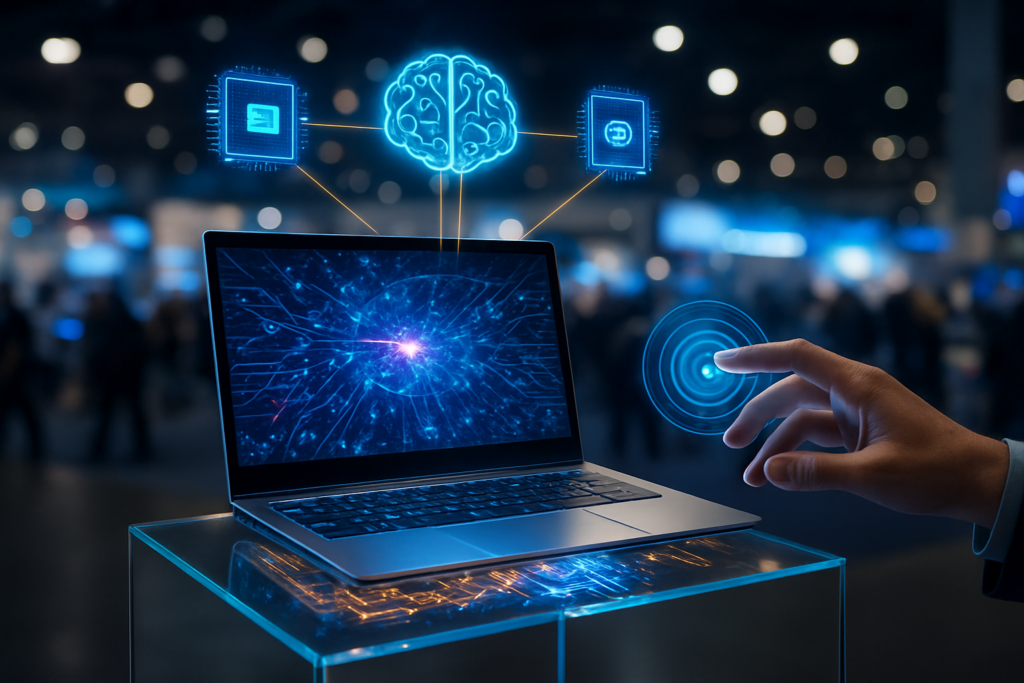
The halls of CES 2026 in Las Vegas have officially signaled the end of the "early adopter" phase for the AI PC, ushering in a new standard of local processing power that dwarfs the breakthroughs of just two years ago. For the first time, every major silicon provider—Intel (Intel Corp, NASDAQ: INTC), AMD (Advanced Micro Devices Inc, NASDAQ: AMD), and Qualcomm (Qualcomm Inc, NASDAQ: QCOM)—has demonstrated silicon capable of exceeding 50 Trillion Operations Per Second (TOPS) on the Neural Processing Unit (NPU) alone. This milestone marks the formal arrival of "Agentic AI," where PCs are no longer just running chatbots but are capable of managing autonomous background workflows without tethering to the cloud.
However, as the hardware reaches these staggering new heights, a growing tension has emerged on the show floor. While the technical achievements of Intel's Core Ultra Series 3 and Qualcomm’s Snapdragon X2 Elite are undeniable, the industry is grappling with a widening "utility gap." Manufacturers are now facing a skeptical public that is increasingly confused by "AI Everywhere" branding and the abstract nature of NPU benchmarks, leading to a high-stakes debate over whether the "TOPS race" is driving genuine consumer demand or merely masking a plateau in traditional PC innovation.
The Silicon Standard: 50 TOPS is the New Floor
The technical center of gravity at CES 2026 was the official launch of the Intel Core Ultra Series 3, codenamed "Panther Lake." This architecture represents a historic pivot for Intel, being the first high-volume platform built on the ambitious Intel 18A (2nm-class) process. The Panther Lake NPU 5 architecture delivers a dedicated 50 TOPS, but the real story lies in the "Platform TOPS." By leveraging the integrated Arc Xe3 "Celestial" graphics, Intel claims total AI throughput of up to 170 TOPS, a leap intended to facilitate complex local image generation and real-time video manipulation that previously required a discrete GPU.
Not to be outdone, Qualcomm dominated the high-end NPU category with its Snapdragon X2 Elite and Plus series. While Intel and AMD focused on balanced architectures, Qualcomm leaned into raw NPU efficiency, delivering a uniform 80 TOPS across its entire X2 stack. HP (HP Inc, NYSE: HPQ) even showcased a specialized OmniBook Ultra 14 featuring a "tuned" X2 variant that hits 85 TOPS. This silicon is built on the 3rd Gen Oryon CPU, utilizing a 3nm process that Qualcomm claims offers the best performance-per-watt for sustained AI workloads, such as local language model (LLM) fine-tuning.
AMD rounded out the "Big Three" by unveiling the Ryzen AI 400 Series, codenamed "Gorgon Point." While AMD confirmed that its true next-generation "Medusa" (Zen 6) architecture won't hit mobile devices until 2027, the Gorgon Point refresh provides a bridge with an upgraded XDNA 2 NPU delivering 60 TOPS. The industry response has been one of technical awe but practical caution; researchers note that while we have more than doubled NPU performance since 2024’s Copilot+ launch, the software ecosystem is still struggling to utilize this much local "headroom" effectively.
Industry Implications: The "Megahertz Race" 2.0
This surge in NPU performance has forced Microsoft (Microsoft Corp, NASDAQ: MSFT) to evolve its Copilot+ PC requirements. While the official baseline remains at 40 TOPS, the 2026 hardware landscape has effectively treated 50 TOPS as the "new floor" for premium Windows 11 devices. Microsoft’s introduction of the "Windows AI Foundry" at the show further complicates the competitive landscape. This software layer allows Windows to dynamically offload AI tasks to the CPU, GPU, or NPU depending on thermal and battery constraints, potentially de-emphasizing the "NPU-only" marketing that Qualcomm and Intel have relied upon.
The competitive stakes have never been higher for the silicon giants. For Intel, Panther Lake is a "must-win" moment to prove their 18A process can compete with TSMC's 2nm nodes. For Qualcomm, the X2 Elite is a bid to maintain its lead in the "Always Connected" PC space before Intel and AMD fully catch up in efficiency. However, the aggressive marketing of these specs has led to what analysts are calling the "Megahertz Race 2.0." Much like the clock-speed wars of the 1990s, the focus on TOPS is beginning to yield diminishing returns for the average user, creating an opening for Apple (Apple Inc, NASDAQ: AAPL) to continue its "it just works" narrative with Apple Intelligence, which focuses on integrated features rather than raw NPU metrics.
The Branding Backlash: "AI Everywhere" vs. Consumer Reality
Despite the technical triumphs, CES 2026 was marked by a notable "Honesty Offensive." In a surprising move, executives from Dell (Dell Technologies Inc, NYSE: DELL) admitted during a keynote panel that the broad "AI PC" branding has largely failed to ignite the massive upgrade cycle the industry anticipated in 2025. Consumers are reportedly suffering from "naming fatigue," finding it difficult to distinguish between "AI-Advanced," "Copilot+," and "AI-Ready" machines. The debate on the show floor centered on whether the NPU is a "killer feature" or simply a new commodity, much like the transition from integrated to high-definition audio decades ago.
Furthermore, a technical consensus is emerging that raw TOPS may be the wrong metric for consumers to follow. Analysts at Gartner and IDC pointed out that local AI performance is increasingly "memory-bound" rather than "compute-bound." A laptop with a 100 TOPS NPU but only 16GB of RAM will struggle to run the 2026-era 7B-parameter models that power the most useful autonomous agents. With global memory shortages driving up DDR5 and HBM prices, the "true" AI PC is becoming prohibitively expensive, leading many consumers to stick with older hardware and rely on superior cloud-based models like GPT-5 or Claude 4.
Future Outlook: The Search for the "Killer App"
Looking toward the remainder of 2026, the industry is shifting its focus from hardware specs to the elusive "killer app." The next frontier is "Sovereign AI"—the ability for users to own their data and intelligence entirely offline. We expect to see a rise in "Personal AI Operating Systems" that use these 50+ TOPS NPUs to index every file, email, and meeting locally, providing a privacy-first alternative to cloud-integrated assistants. This could finally provide the clear utility that justifies the "AI PC" premium.
The long-term challenge remains the transition to 2nm and 3nm manufacturing. While 2026 is the year of the 50 TOPS floor, 2027 is already being teased as the year of the "100 TOPS NPU" with AMD’s Medusa and Intel’s Nova Lake. However, unless software developers can find ways to make this power "invisible"—optimizing battery life and thermals silently rather than demanding user interaction—the hardware may continue to outpace the average consumer's needs.
A Crucial Turning Point for Personal Computing
CES 2026 will likely be remembered as the year the AI PC matured from a marketing experiment into a standardized hardware category. The arrival of 50+ TOPS silicon from Intel, AMD, and Qualcomm has fundamentally raised the ceiling for what a portable device can do, moving us closer to a world where our computers act as proactive partners rather than passive tools. Intel's Panther Lake and Qualcomm's X2 Elite represent the pinnacle of current engineering, proving that the technical hurdles of on-device AI are being cleared with remarkable speed.
However, the industry's focus must now pivot from "more" to "better." The confusion surrounding AI branding and the skepticism toward raw TOPS benchmarks suggest that the "TOPS race" is reaching its limit as a sales driver. In the coming months, the success of the AI PC will depend less on the trillion operations per second it can perform and more on its ability to offer tangible, private, and indispensable utility. For now, the hardware is ready; the question is whether the software—and the consumer—is prepared to follow.
This content is intended for informational purposes only and represents analysis of current AI developments.
TokenRing AI delivers enterprise-grade solutions for multi-agent AI workflow orchestration, AI-powered development tools, and seamless remote collaboration platforms.
For more information, visit https://www.tokenring.ai/.