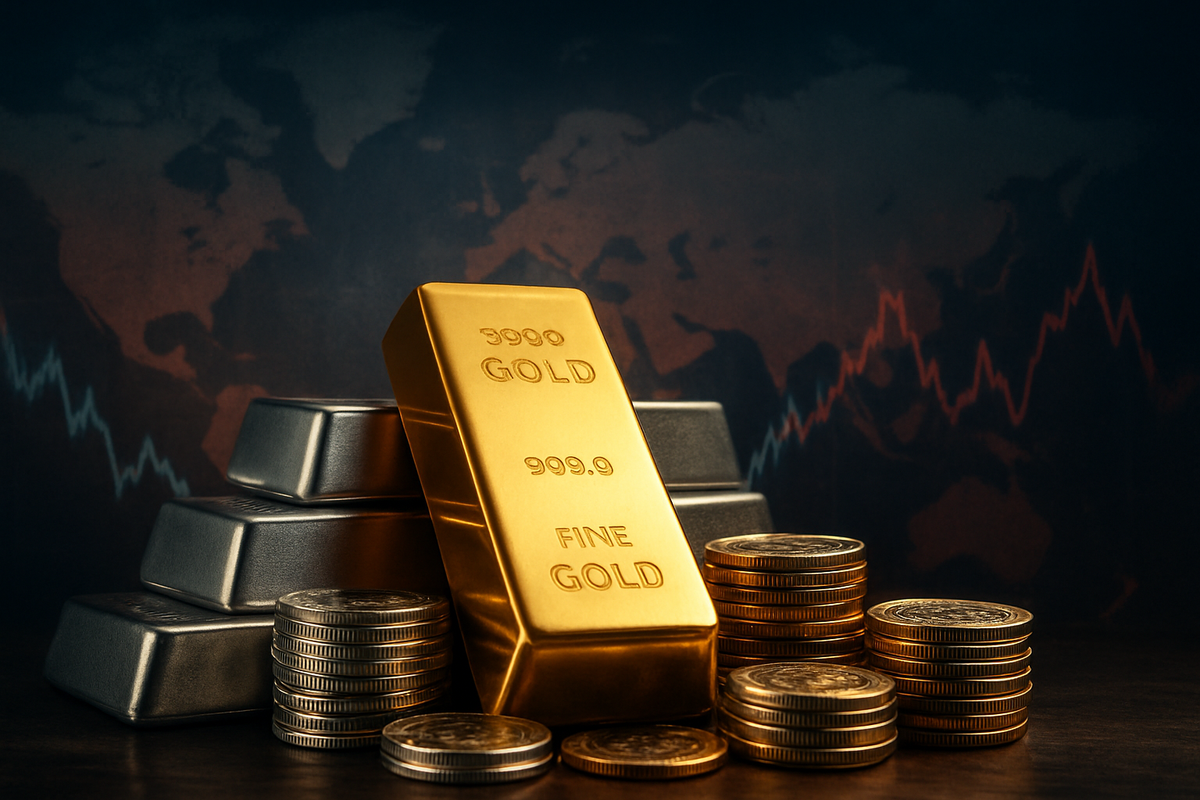
The global financial markets are currently witnessing a historic surge in the prices of gold and silver, with both precious metals reaching new all-time record highs in late 2024 and throughout 2025. This remarkable rally is primarily fueled by an escalating confluence of geopolitical tensions, pervasive global growth uncertainty, and a strategic shift in central bank policies. The immediate implications are far-reaching, impacting investor portfolios, industrial sectors, and the broader landscape of global economic stability.
This unprecedented rise underscores the enduring role of gold and silver as safe-haven assets, attracting significant capital from investors seeking refuge from turbulent markets. As central banks diversify reserves away from traditional dollar-denominated holdings and industries grapple with supply deficits, the precious metals market is experiencing a fundamental re-evaluation, signaling a potential paradigm shift in global asset allocation strategies.
A Historic Ascent: Unpacking the Gold and Silver Rally
The year 2025 has been nothing short of extraordinary for precious metals, with gold and silver shattering multiple previous records. Gold reached an all-time high of $4381.58 per troy ounce in October 2025, and as of December 15, 2025, was trading around $4345.98 USD/t.oz, representing a staggering 63.90% increase year-over-year. Similarly, silver achieved an all-time high of $64.66 per troy ounce in December 2025, trading at approximately $63.89 USD/t.oz on December 15, 2025, marking an astounding 109.40% increase compared to December 2024.
This monumental surge is the culmination of events that began in late 2024 and intensified throughout 2025. Late 2024 saw gold prices initially climb due to escalating geopolitical tensions, including conflicts in the Middle East, and growing concerns about a global economic slowdown. Central banks globally significantly ramped up gold acquisitions, with the U.S. Federal Reserve initiating accommodative monetary policies, including interest rate reductions, which made non-yielding assets more attractive. Silver also benefited from strong industrial demand, reaching its highest levels since 2013.
Throughout 2025, these drivers only strengthened. Ongoing conflicts in Eastern Europe and rising tensions between the U.S. and China further cemented gold's safe-haven appeal. Persistent inflationary pressures across major economies spurred investors to seek hedges against the erosion of purchasing power. The Federal Reserve continued its rate-cutting cycle, delivering a third 25bps cut in the week leading up to December 15, 2025, which immediately boosted precious metal prices. A weakening U.S. dollar, which depreciated by nearly 10% in 2025, made dollar-denominated commodities more affordable for international buyers. For silver, tightening physical inventories and robust industrial demand from sectors like solar panels and electric vehicles contributed to a global supply squeeze. Notably, silver was added to the U.S. Geological Survey's list of critical minerals in November 2025, further highlighting its strategic importance and boosting investor interest. Major gold and silver producers also reduced forward sales, signaling confidence in a sustained higher price environment.
Key players driving this surge include central banks worldwide, particularly those in emerging markets like China, Poland, and India, which have been substantial buyers of gold to diversify reserves. The U.S. Federal Reserve's monetary policy decisions, especially its interest rate cuts, have significantly influenced market liquidity. Both retail and institutional investors have shown a strong bullish outlook, increasing open interest in futures and driving robust inflows into Exchange Traded Funds (ETFs). The industrial sector, heavily reliant on silver for electronics, solar, and EVs, represents a significant source of demand. Finally, mining companies and governments (through policies like critical mineral designations) also play crucial roles in supply and market sentiment. Initial market reactions have been characterized by immediate price appreciation following key announcements, increased volatility, and a strong bullish sentiment, with silver notably outperforming gold in percentage gains.
Corporate Fortunes: Who Wins and Who Loses?
The unprecedented surge in gold and silver prices has created a clear divide between beneficiaries and those facing significant headwinds across various public companies.
Winners:
Gold and Silver Mining Companies are the most direct beneficiaries. Higher commodity prices translate directly into increased revenue and expanded profit margins, assuming stable production costs. Many mining stocks offer leveraged exposure, often outperforming the metals themselves. Companies like Barrick Gold Corporation (NYSE: GOLD) have seen significant share price appreciation (up 207% in Q3 2025), driven by strategic partnerships, reduced debt, and strong free cash flow. Agnico Eagle Mines Limited (NYSE: AEM) has demonstrated superior cost control, leading to a 291% 3-year return. Kinross Gold Corporation (NYSE: KGC) was up 113% year-to-date in August 2025. Royalty and streaming companies like Wheaton Precious Metals (NYSE: WPM), Franco-Nevada Corporation (NYSE: FNV), and Royal Gold, Inc. (NASDAQ: RGLD) also benefit significantly from rising prices with lower operational risks. In silver, major producers like Fresnillo Plc (LSE: FRES) have seen their share prices soar (up 343% year-to-date), while Pan American Silver (NYSE: PAAS) and First Majestic Silver (NYSE: AG) have delivered substantial one-year returns, bolstered by acquisitions and strong earnings growth.
Precious Metals ETFs/Funds, such as the VanEck Junior Gold Miners ETF (NYSEARCA: GDXJ) and VanEck Gold Miners ETF (NYSEARCA: GDX), have also seen significant inflows and outperformance, with GDXJ up 167% and GDX up 153% year-to-date.
Losers and Impacted Companies:
Jewelry Retailers and Manufacturers face significant challenges. Soaring raw material costs for gold and silver directly impact their cost of goods sold, squeezing profit margins or necessitating price increases. This can dampen consumer demand, as seen in India where silver jewelry demand fell 14%. Companies like Tiffany & Co. (NYSE: TIF, now part of LVMH) and other luxury jewelers may need to adjust pricing strategies or product offerings, potentially introducing lower-karat gold or more affordable alternatives.
Industrial Users of Gold and Silver are also feeling the pinch of increased input costs. Silver, in particular, is critical for numerous high-tech applications. Electronics Manufacturers such as Apple Inc. (NASDAQ: AAPL), Samsung Electronics Co., Ltd. (KRX: 005930), Intel Corporation (NASDAQ: INTC), and Qualcomm Incorporated (NASDAQ: QCOM) rely on silver for smartphones, 5G infrastructure, and semiconductors, meaning higher silver prices directly increase their production expenses. Solar Panel Manufacturers, including JinkoSolar Holding Co., Ltd. (NYSE: JKS), face increased costs for silver, a vital component in solar cells. Similarly, Electric Vehicle (EV) Manufacturers like Tesla, Inc. (NASDAQ: TSLA) and General Motors Company (NYSE: GM) use significantly more silver per vehicle, leading to higher material costs. While these industries may explore "thrifting" initiatives to reduce silver content or seek alternative materials, silver's superior conductivity often makes substitution difficult in the short term, potentially impacting profitability or leading to higher consumer prices for their products.
Broader Implications: A Shift in Global Dynamics
The current surge in gold and silver prices is not an isolated event but rather a profound reflection of several broader industry trends and a significant re-evaluation of global financial stability. This rally, with gold consistently trading above $4,000 per ounce and silver breaking past $60, is embedded in a landscape of persistent economic uncertainty, escalating geopolitical fragmentation, and a strategic shift in global monetary policies.
The trend of central bank accumulation is particularly noteworthy. Central banks worldwide, especially in emerging markets, have been aggressively diversifying their reserves away from the U.S. dollar, driven by geopolitical risks and a desire for financial insulation. This sustained institutional demand provides a robust floor for gold prices. Simultaneously, persistent inflation and currency debasement concerns are driving investors towards tangible assets, viewing gold and silver as essential hedges against the erosion of fiat currency purchasing power. For silver, its dual role as a safe-haven asset and a critical industrial metal in the green energy revolution (solar panels, electric vehicles) and advanced electronics (AI, 5G) creates a unique and powerful demand narrative, contributing to a projected fifth consecutive year of supply deficits in 2025.
The ripple effects are extensive. In the jewelry industry, soaring precious metal costs are forcing manufacturers to adapt, leading to a decline in demand for high-carat gold jewelry and a shift towards more affordable alternatives. For the electronics and automotive industries, higher silver prices translate to increased production costs, potentially impacting profitability or consumer prices for critical components and products. Conversely, mining companies are poised for increased revenues, though persistent supply deficits for silver, often a byproduct, pose challenges for rapidly scaling production.
From a regulatory and policy standpoint, the U.S. Federal Reserve's monetary policy decisions regarding interest rates and quantitative easing remain critical drivers, influencing the attractiveness of non-yielding assets. Trade and tariff policies contribute to global economic uncertainty, further enhancing gold's safe-haven appeal. Furthermore, silver's recent inclusion on the U.S. critical minerals list highlights its strategic importance and could lead to policies aimed at securing supply chains.
Historically, the current rally draws parallels to the 1970s inflationary period, where gold prices skyrocketed amidst geopolitical tensions and a weakening dollar, and the 2008 Global Financial Crisis, when investors sought safe havens. However, the present scenario in 2025 is unique due to an unprecedented confluence of factors: record-setting central bank gold buying, persistent geopolitical instability, and a structurally driven industrial demand for silver in new technologies. This suggests a potentially more sustained precious metal bull market rather than a purely cyclical dynamic, marking 2025 as one of the strongest years for precious metals in over a decade.
The Road Ahead: Navigating the Precious Metals Landscape
Looking ahead, the outlook for gold and silver prices remains broadly bullish for both the short and long term, albeit with anticipated periods of consolidation following the rapid gains of 2025. The confluence of economic, monetary, and geopolitical factors is expected to continue providing strong tailwinds.
In the short term (2026), gold is widely anticipated to continue its upward trajectory, with forecasts generally clustering around $4,500–$4,700 per ounce, and some projections even extending towards $5,000. Key drivers include expected U.S. Federal Reserve easing, robust central bank and retail demand, and persistent global debt concerns. Silver is expected to continue its strong outperformance, with price targets ranging from $60–$80 per ounce, and some aggressive forecasts suggesting it could test $100 by the end of 2026. This will be primarily driven by surging industrial demand from the solar, EV, and electronics sectors, coupled with persistent global supply deficits. However, a "Reflation Return" scenario with strong economic growth, higher interest rates, and a stronger U.S. dollar could lead to a correction.
For the long term (2027-2030 and beyond), the outlook remains structurally bullish for both metals. Gold is projected to continue its ascent, potentially approaching $5,150 to $6,200 by 2030, with some aggressive forecasts even suggesting $10,000. This will be underpinned by continued central bank demand, geopolitical shifts, and declining confidence in fiat currencies. Silver is poised for an industrial super-cycle, with forecasts suggesting it could climb to $133–$143 per ounce by 2027-2030, and potentially exceeding $200 by 2030, driven by its indispensable role in the green energy transition and technology.
Strategic pivots or adaptations for investors include increased portfolio diversification, with many advisors recommending a 5-10% allocation to precious metals. Dollar-cost averaging can help mitigate timing risk given current elevated prices. Understanding silver's higher volatility and its historical undervaluation relative to gold (as indicated by the gold-to-silver ratio) presents opportunities for "Ratio Trades." Investors can gain exposure through physical metals, ETFs like SPDR Gold Shares (NYSEARCA: GLD) and iShares Silver Trust (NYSEARCA: SLV), or mining stocks.
Market opportunities abound in the form of inflation and currency debasement hedges, safe-haven demand, silver's industrial super-cycle, and continued central bank accumulation. However, challenges include high valuation risk, increased volatility, the potential for hawkish central bank policies, and the impact of a severe economic downturn on silver's industrial demand. Potential scenarios range from a moderately bullish baseline, where both metals continue a gradual upward trend, to a strong bull market driven by heightened geopolitical risks and aggressive central bank easing, or a correction triggered by a strong economic recovery and tighter monetary policy. A distinct "silver-led industrial super-cycle" could also see silver's price climb significantly due to technology adoption, even if gold's monetary drivers are somewhat subdued.
Concluding Thoughts: A New Era for Precious Metals
The gold and silver price surge of 2025 marks a pivotal moment, signaling a significant "structural shift" in demand and pricing drivers that is likely to have a lasting impact on global financial markets. Gold's break above the $4,000 mark is more than just a new record; it reflects a growing retreat from the dominance of the U.S. dollar as nations and institutions increasingly seek political and financial independence and diversification from fiat currencies. The "everything bubble" theory, suggesting potentially unsustainable market conditions driven by unprecedented global liquidity, further underscores the appeal of these tangible assets.
Moving forward, the market is poised for a sustained elevated baseline for precious metal prices. This will be driven by ongoing geopolitical fragmentation, persistent inflation concerns, and a global monetary easing environment. Silver's increasingly critical role in green energy technologies and advanced electronics highlights its growing industrial importance, which, coupled with persistent supply tightness, could lead to continued and robust price support for years to come.
Investors should remain vigilant and closely monitor several key indicators in the coming months. These include the Federal Reserve's forward guidance on interest rates, global inflation data, the evolution of geopolitical developments, the strength of the U.S. dollar, and industrial demand trends for silver. Continuous central bank gold buying will also be a crucial factor to watch. Given the current high price levels and potential for consolidation, experts advise a staggered investment approach, such as Systematic Investment Plans (SIPs) in Gold/Silver ETFs, rather than lump-sum purchases. A balanced portfolio with a modest allocation to gold and silver is often recommended for diversification and risk mitigation in an increasingly uncertain global economic landscape. The current environment strongly suggests that precious metals are reasserting their traditional roles as essential components of a resilient investment strategy.
This content is intended for informational purposes only and is not financial advice